


Heterogeneous debt durations and the inflation target
In this paper, Andreolli and Rey examine the fiscal consequences for individual countries when the ECB misses its inflation target for a long period of time. They use the Duration-to-GDP measure which calculates the net present value of debt servicing costs savings after a permanent one percent increase in interest rates across the yield curve. Debt-to-GDP measures these savings not in terms of debt but in terms of debt servicing costs over GDP. They find:
When a Central Bank systematically misses its inflation target on one side for a long period, this can have large implications for the fiscal costs of the countries in the currency union. In case the central bank undershoots its target the larger the Duration-to-GDP, the larger the costs. And those costs are amplified when the Central Bank is credible as agents keep expecting a return to target, which is priced in long-dated bonds and persistently not happening. Fiscal costs of countries such as Italy or Belgium having chosen to issue relatively long maturity debt and having large debt levels are close to 30 points of GDP (accumulated debt) higher during the 2000-2021 period than if they had issued short term debt, whose price reflects realised inflation more closely than long dated instruments.
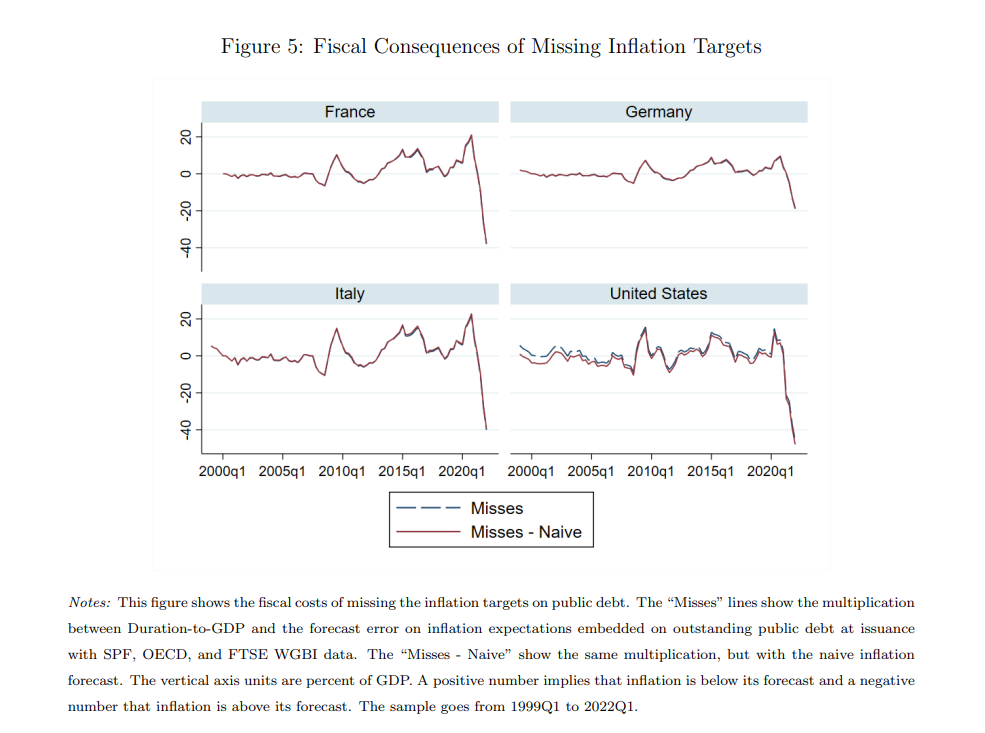 The Fiscal Consequences of Missing an Inflation Target
Authors: Michele Andreolli, Hélène Rey
From: London Business School
