


Extreme weather and growth risk
This research paper by Marcelle Chauvet, Claudio Morana, and Murilo Silva examines the relationship between deteriorating extreme weather conditions and anthropogenic greenhouse gas emissions, along with their economic consequences across 40 European countries from 1981 to 2023. The authors use the European Extreme Events Climate Index (E3CI) with 7 components (extreme temperatures, wind, precipitation, droughts, wildfires, hail). Chauvet et al. implement an innovative panel regression-based trend-cycle decomposition that separates medium-to-long-term trends from short-term fluctuations. In addition, they use a Growth-at-Risk framework to examine effects across the entire GDP growth distribution rather than just mean effects.
Findings
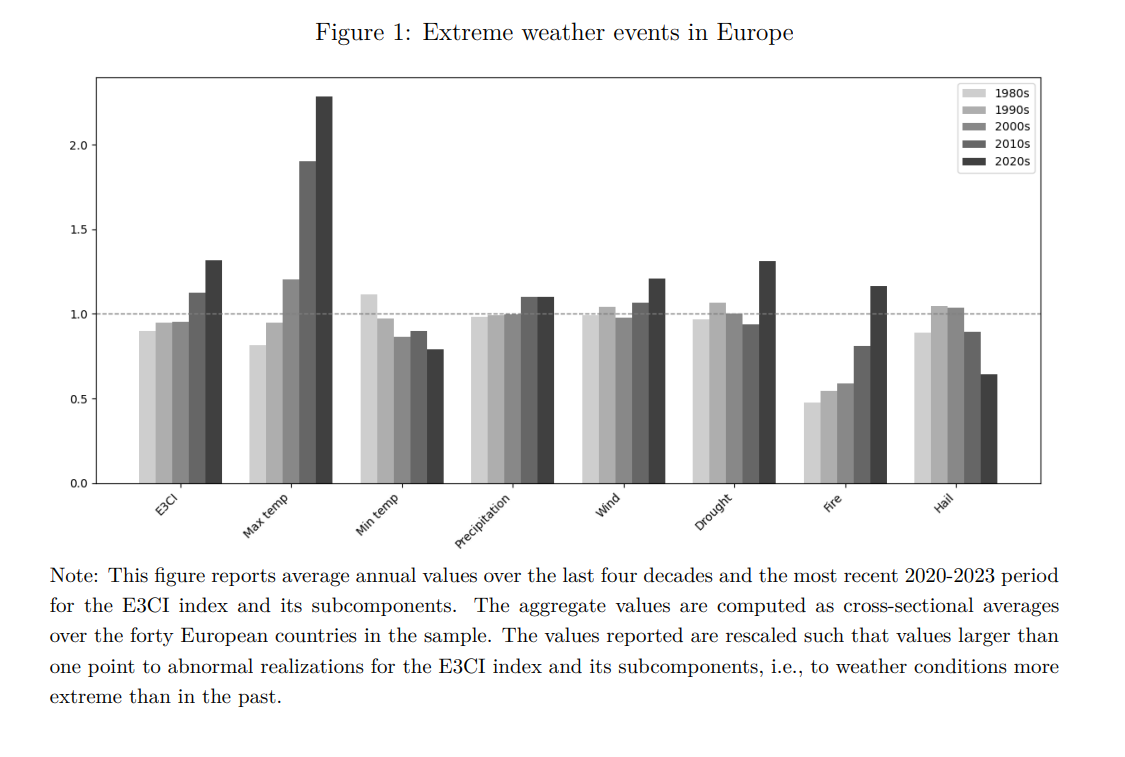
The analysis reveals that common components strongly dominate idiosyncratic effects, consistent with the global nature of climate change and confirming that climate impacts transcend national boundaries. Over the study period, the E3CI index shows significant deterioration:
- Extreme heat events increased by over 180% compared to the 1980s baseline
- Wildfire frequency rose by 150%
- Drought episodes increased by 30%
- Extreme precipitation and wind events increased by 10-20%
The Growth-at-Risk analysis reveals profound asymmetric effects of extreme weather on economic growth:
- Distributional impact: Deteriorating extreme weather conditions negatively affect the entire GDP growth distribution, but the impact on downside risk is approximately four times greater than on upside risk. For example, the impact on the 0.3 quantile (-4.0%) is about four times that of the 0.7 quantile (-1.2%).
- Component-specific effects:
– Extreme maximum temperature, wind speed, drought, and wildfires show stronger negative impacts on downside rather than upside growth risk
– Extreme minimum temperature and precipitation affect upside risk more than downside risk
– Hail events show no significant economic impact - Under a business-as-usual scenario, the research projects:
– Median contraction of approximately -0.15% per year in trend real per capita GDP growth
– Expected annual impact range from -0.08% to -0.25% depending on the growth quantile
– These estimates align with European Environment Agency assessments of climate-related economic losses
Extreme Weather in Europe: Determinants and Economic Impact
Authors: Marcelle Chauvet, Claudio Morana, Murilo Silva
From: University of California Riverside, Università di Milano Bicocca
Extreme weather and regional level impacts
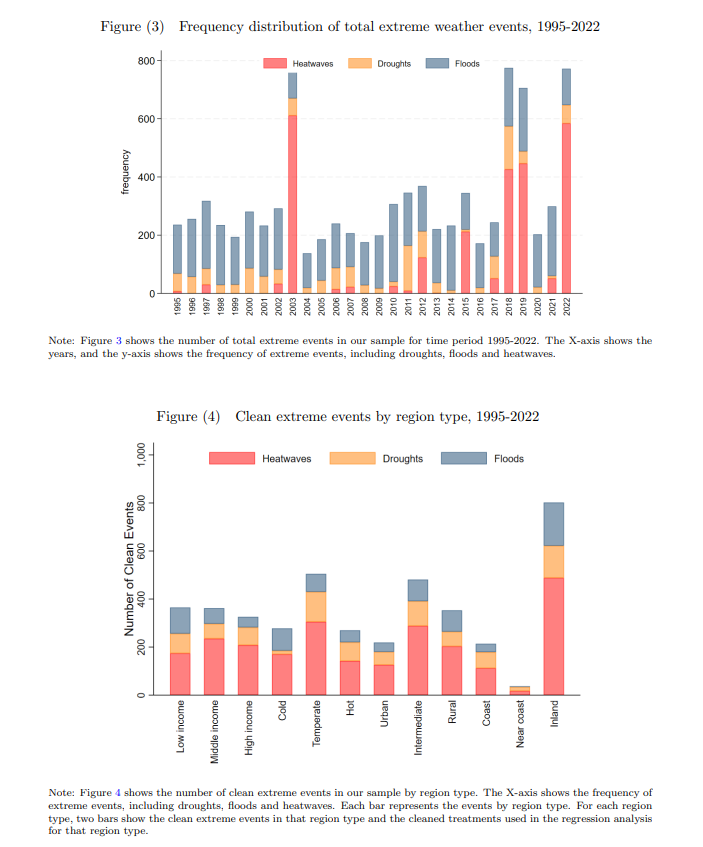
This research by Sehrish Usman, Guzmán González-Torres Fernández, and Miles Parker analyzes the medium-term macroeconomic effects of extreme climate events across 1,160 EU regions from 1995-2022 using a local projections difference-in-difference framework. The research represents a methodological innovation by examining regional-level impacts rather than national aggregates, employing objective meteorological criteria to define extreme events, and conducting growth accounting analysis over five-year horizons. The authors use high-resolution ERA5 weather data to define three types of extreme events: heatwaves (temperature anomalies exceeding ±1.5°C), droughts (three consecutive months with precipitation below 50% of historical means), and floods (Standardized Precipitation Index above 2). Regional output is decomposed into capital stock, labor supply, and total factor productivity using a Cobb-Douglas production function, with regions classified by climate baseline, income levels, and geographic characteristics.
Key findings by event type
- Summer heatwaves cause 1.4 percentage points lower output after four years. The economic mechanism reveals initial employment declines followed by substantial adaptation spending that increases capital but reduces total factor productivity. This “adaptation paradox” means necessary climate investments actually lower regional productivity since adaptation capital is less productive than standard investments.
- Droughts produce the most severe impacts with 2.4 percentage points lower output after four years. Unlike heatwaves, droughts operate primarily through persistent labor market damage—declining investment, employment, and hours worked—with limited capital recovery. The effects develop gradually and compound over time.
- Floods show highly heterogeneous outcomes dependent on regional wealth. High-income regions experience reconstruction booms with increased investment and “building back better” dynamics that improve both output and productivity. Low-income regions show little recovery, highlighting how financial constraints prevent effective post-disaster rebuilding.
- The research challenges conventional disaster economics by demonstrating that extreme events create escalating rather than temporary impacts. Instead of initial disruption followed by recovery, the study finds that “uncertainty, income losses, disruption and emigration can depress demand, and the lower activity and employment can persist, and endogenously lower potential output”.
- Demographic consequences include significant population decline in affected regions, with net migration falling and total population decreasing by approximately 4% four years after droughts. This demographic drain compounds the economic damage by reducing the labor force in already struggling regions.
- Sectoral impacts vary significantly, with agriculture suffering persistent damage from droughts and heatwaves, while manufacturing and services show mixed results depending on regional adaptation capacity.
Going NUTS: the regional impact of extreme climate events over the medium term
Authors: Sehrish Usman, Guzmán González-Torres Fernández, Miles Parker
From: ECB
