


How is the euro doing?
In this policy brief, Buti and Corsetti provide a comprehensive analysis of the history of the euro area in four phases: the decade of over-optimism (1999-2008), the decade of crises and fragmentation (2009-2019), the test of a large exogenous shock (COVID-19) (2020-2021), and the inflation surge (2022-2023). The authors discuss key economic indicators and institutional developments during each phase. They highlight the challenges faced by the euro, including the underpricing of economic and corporate risk, the imbalances within the euro area, and the incomplete architecture of the monetary union. They argue that the main economic indicators during the decade of over-optimism (1999-2008) in the euro area included the following:
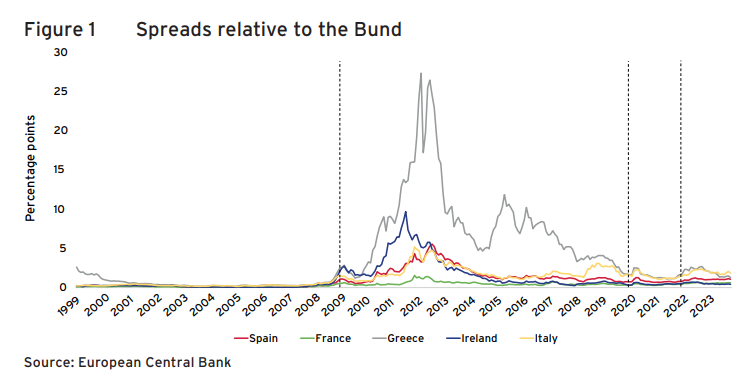
- Interest Rate Convergence: There was a fast and lasting convergence in interest rates across borders, giving a false feeling of security. This led to governments of traditionally vulnerable countries postponing genuine fiscal adjustment and entering a state of structural reforms anesthesia.
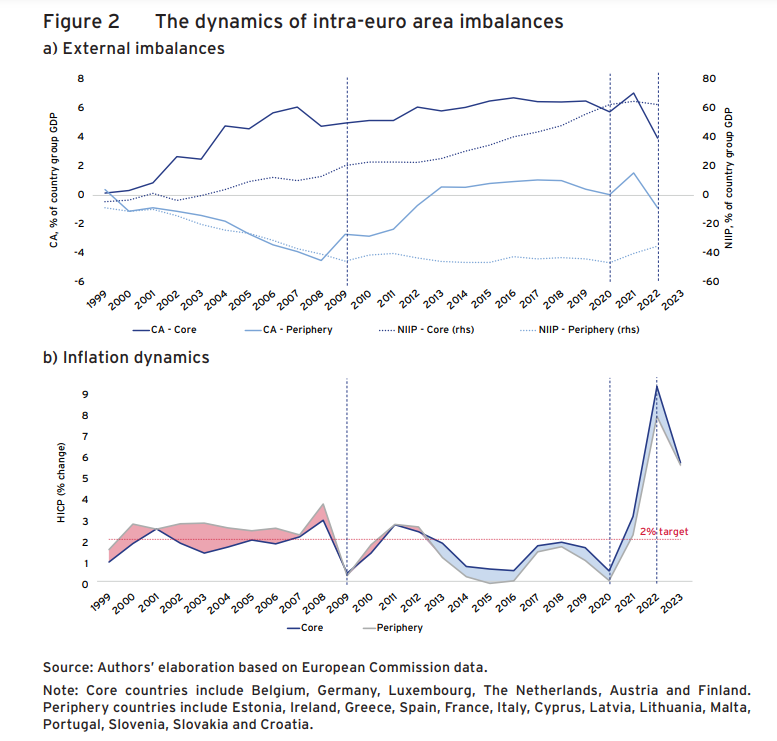
- Inflation Differentials: Persistent inflation differentials remained across borders, with an unexpected ‘convergence’ in non-tradeable prices to the level in the richest region of the union.
- Current Account Imbalances: While the current account of the euro area balance of payments remained broadly balanced, cross-border current account deficits and surpluses inside the euro area ballooned, contributing to economic and financial imbalances.
- Structural Divergence: The introduction of the euro ignited profound changes in national economic structures, eventually weighing on social preferences and attitudes towards structural reform. The economies of the core countries became more intensive in tradeables, while those of peripheral countries became more intensive in non-tradeables.
What needs to be done going forward?
- There is a need for a cooperative framework governing the interactions between monetary and fiscal authorities, otherwise ECB independence would morph into ‘loneliness’ and the ECB would easily fall victim to public discontent whenever it has to take unpopular decisions.
- The euro area-wide fiscal stance needs vertical coordination: the overriding concern in the redesign of the fiscal rules is how to frame a regime for effective deleveraging.
- The supply of European public goods should be at the core of an EU industrial policy.
- The Financial Union needs a new narrative, one that emphasizes how a fully integrated banking market and a safe asset will enable the EU not to be vulnerable to shocks and instead play an effective role in global governance.
[A]gainst all odds, EMU has proven to be resilient … The political drive underlying its creation, which seemingly withers away in normal times, resurfaces powerfully, especially when crises threaten the survival of the common currency. Indeed, historical records confirm the leitmotiv in the EU narrative: the ‘true reaction function’ of Europeans emerges only in conditions of extreme distress. But the same records also show that steps forward only come at higher-than-necessary and social costs. Looking forward, to keep counting on the idea that the right decisions are (eventually) made only under distress is risky. At 25, the key challenge for the euro area is to learn to design and implement the necessary reforms in ‘normal times’.
The first 25 years of the euro
By: Marco Buti, Giancarlo Corsetti – European University Institute
