• Twitter
  • Search
e-axes

360° Econ View

The issues, the debates, and the research

  • Home
  • Useful Data
  • About
  • Contact
  • Home
  • Useful Data
  • About
  • Contact

Financial Markets

The drop in US listed firms

Posted by e-axes on April 2, 2019

Read Next →

Financial Markets

When Markets Drift from the Real Economy

Financial Markets

Gold, the Dollar, and the Geopolitics of Global Reserves

Financial Markets

From Information to Liquidity: How Stablecoins Reshape Bank Intermediation

Small firms are fleeing that US stock exchanges

Doidge and al. find that as of the end of 2016, the number of listed firms was 25% less than in 1975 and 52% less than its peak in 1997. They also find that it is the small firms that have left the exchanges increasingly and that this is largely a US phenomenon. A possible explanation is the shift from physical investment to R&D ie. investment in intellectual capital. More specifically:

If a firm is building a new plant, it is easy for it to disclose that it is doing so. Nobody can steal the plant. The same is not the case if the firm has an intensive R&D program. By disclosing details of that program, a firm gives away some of its ideas. Other firms can build on what they learn.
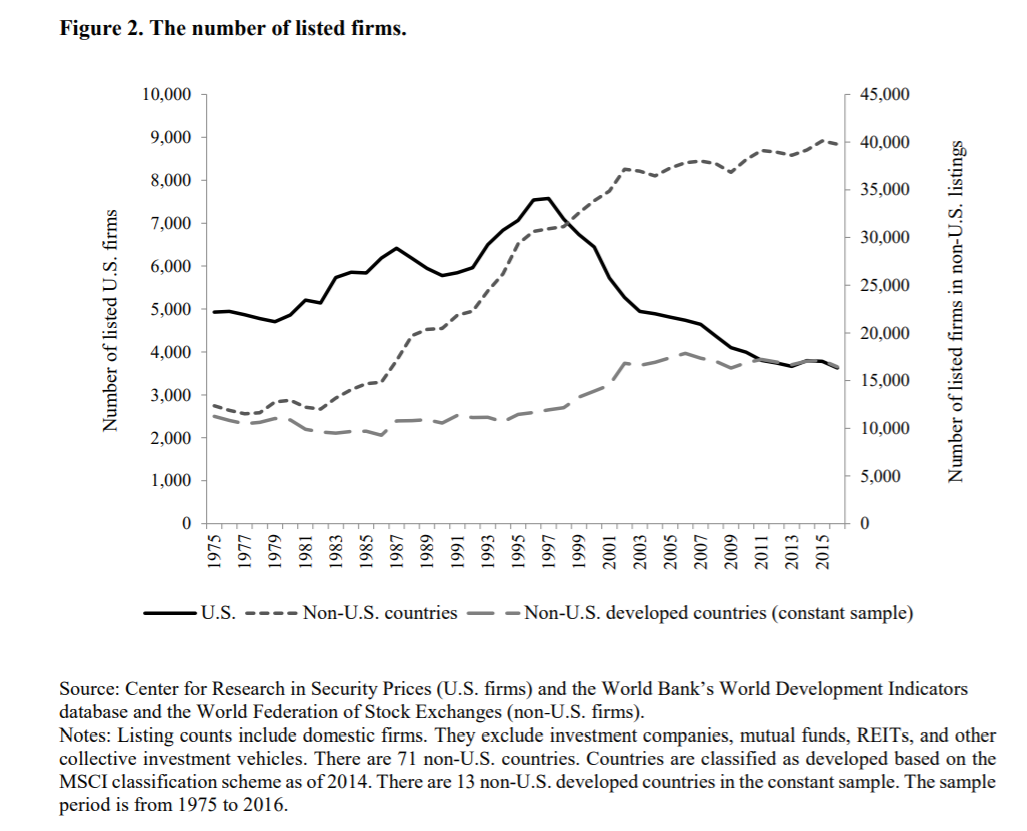
Eclipse of the public corporation or eclipse of the public markets?
Authors: Craig Doidge, Kathleen M. Kahle, G. Andrew Karolyi, René M. Stulz
From: University of Toronto, University of Arizona, Cornell University, The Ohio State University

The importance of “unicorns”

Bowen and al. provide a qualification to the Doidge and al. finding: they argue that private firms that can develop an independent market presence by creating new markets or disrupting existing ones with patented technologies are more likely to scale up through a public listing. But these firms are very few.
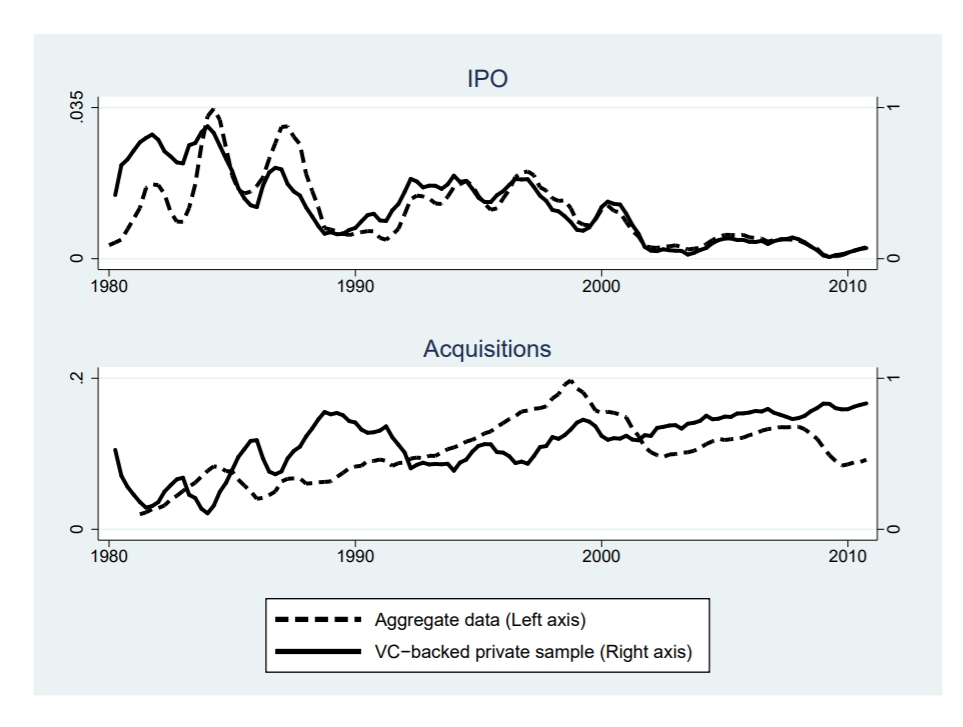
Technological Disruptiveness and the Evolution of IPOs and Sell-Outs
Authors: Donald Bowen, Laurent Fresard, and Gerard Hoberg
From: Virginia Tech, University of Lugano, Swiss Finance Institute, University of Southern California

…or is it the effect of deregulation?

The deregulation of securities laws in the 1990s—and in particular the National Securities Markets Improvement Act of 1996—has facilitated the process of raising capital privately and been a key driver of the decline in U.S. IPOs. Privately-held startups are now able to grow to a size historically available only to their public peers. The IPO decline is not a market failure in the process of going public. Rather, it is the result of founders taking advantage of their increased bargaining power and lower cost of being private to realize their preference for control by choosing to remain private.

The Deregulation of the Private Equity Markets and the Decline in IPOs
Authors: Michael Ewens and Joan Farre-Mensa
From: California Institute of Technology, Northeastern University

Print Friendly, PDF & Email

e-axes

Read Next →

Financial Markets

When Markets Drift from the Real Economy

Financial Markets

Gold, the Dollar, and the Geopolitics of Global Reserves

Financial Markets

From Information to Liquidity: How Stablecoins Reshape Bank Intermediation

Comments are Closed

Account

  • Login

Subscriptions

You are not logged in.
Login
Subscribe

Subscriptions

Subscribe

Most Read

  • Public Debt Maturity and Macroeconomic Policy Transmission
  • Bank Heterogeneity and the Transmission of Monetary Tightening
  • AI, Knowledge and the Future of Human Expertise
  • AI Valuations, Capital Investment, and Growth
  • New and Noteworthy Books in Economics (September)
  • AI and the Natural Rate: Puzzle or Policy Challenge?
  • Macroeconomic Risk: From Scenario Synthesis to Distributional Transmission
  • Transfers, Taxes, and the Ricardian Equivalence
  • Can Institutions Limit the Economic Damage of Populism?
  • Asia’s Expanding Non-Dollar Payment Networks

Sections

  • AI
  • Banking
  • Books
  • Brexit
  • CBDC
  • China
  • Climate
  • COVID-19
  • Crypto
  • Demographics
  • Economic Growth
  • Economic Science
  • Economics of Information
  • Emerging Markets
  • Eurozone
  • Financial Markets
  • Geoeconomics
  • Geopolitics
  • India
  • Inequality
  • Inflation
  • International Economics
  • Macro
  • Markets
  • Monetary Policy
  • Oil
  • Politics & Economics
  • Taxation
  • Tech
  • Trade
  • U.S.
  • Ukraine-Russia War
  • Uncategorized
  • Useful Data

© 2026 e-axes

  • Privacy Policy & Terms of Service

Theme by Anders Norén

This website uses cookies to improve your experience. We'll assume you're ok with this, but you can opt-out if you wish.
Cookie settingsAccept
Privacy & Cookies Policy

Privacy Overview

This website uses cookies to improve your experience while you navigate through the website. Out of these cookies, the cookies that are categorized as necessary are stored on your browser as they are as essential for the working of basic functionalities of the website. We also use third-party cookies that help us analyze and understand how you use this website. These cookies will be stored in your browser only with your consent. You also have the option to opt-out of these cookies. But opting out of some of these cookies may have an effect on your browsing experience.
Necessary
Always Enabled
Necessary cookies are absolutely essential for the website to function properly. This category only includes cookies that ensures basic functionalities and security features of the website. These cookies do not store any personal information.
SAVE & ACCEPT