


The impact of “unconventional fiscal policy” measures on inflation
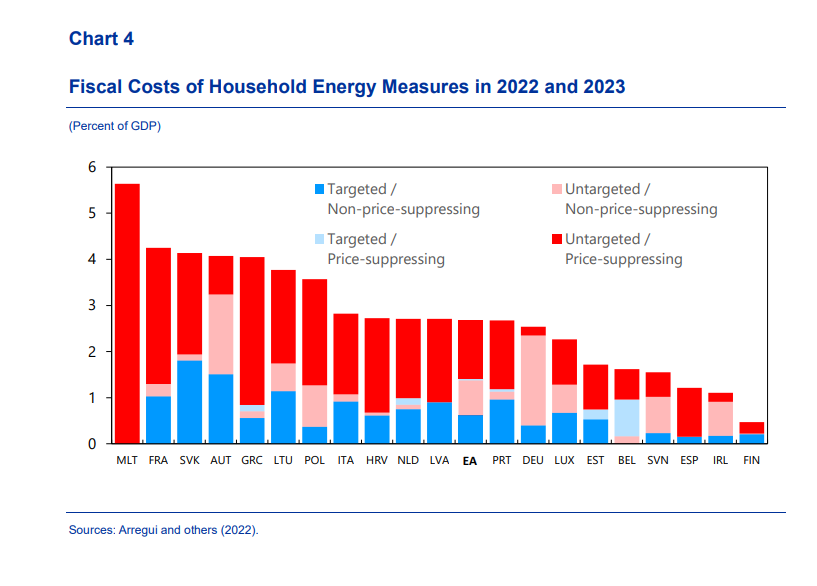
In response to the surge of energy prices due to the Ukranian war, many European countries in 2022 used a combination of transfers, energy subsidies, and tax cuts, in order to contain this increase for households and businesses. In this paper, Dao et al. analyze the impact of these “unconventional fiscal policy” (UFP) measures on inflation in euro area. The main arguments against these measures were: a) these reductions in energy prices would keep energy demand too high; b) the budgetary cost of these measures estimated at 3.3% of GDP for the euro area, would delay much-needed debt reduction; and c) these measures would eventually increase inflation hampering central banks’ anti-inflation efforts.
The authors use the IMF’s Flexible System of Global Models (FSGM) to run simulations under two scenarios: The first scenario assumes that the supply-side factors that caused a spike in international energy prices observed in 2022 unwind in 2023 and 2024. The second scenario assumes that the impact of the UFP measures on the deficit is offset by cuts to government consumption. They find that:
- UFP can smooth inflation in response to a temporary energy price shock while leaving cumulative inflation largely unchanged.
- In this class of models, the inflation-reducing impact of a fiscal tightening is modest.
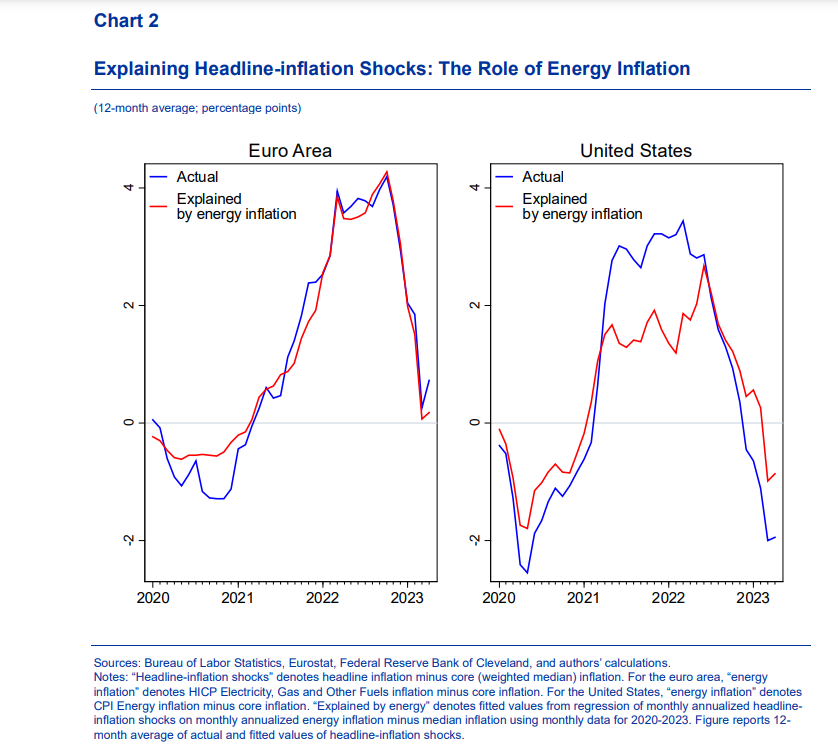
Finally, they decompose inflation in the euro area into core inflation and deviations of headline inflation from core. “The latter are driven by relative price changes in particular industries. The former responds to longer-term expected inflation, slack or tightness in labor markets, and the pass-through of industry price shocks to core inflation, thus capturing with a reduced-form approach the Phillips curve nonlinearities described previously.” The authors then construct counterfactual headline inflation paths that would have occurred in the absence of UFP measures, assuming all else remained equal. The main result of the paper:
[W]ithout the energy price measures that governments have implemented, euro area headline inflation would have been higher in 2022 by about 2 percentage points. About one third to one-half of this difference reflects the direct impact of UFP measures on headline inflation. Much of the remainder reflects a lower pass-through into core inflation, which has displayed a highly nonlinear dynamic. Moreover, despite their fiscal cost, the measures’ effects on raising core inflation by stimulating aggregate demand have been modest thus far, in part because the euro area has not been excessively overheated (much less so than the United States, for example). Finally, during 2023 and 2024, as energy prices are expected to continue to decline, the unwinding of the UFP measures stabilizes inflation on the way down, by avoiding an undershoot of the target.
Unconventional Fiscal Policy in Times of High
Inflation
Authors: Mai Chi Dao, Allan Dizioli, Chris Jackson, Pierre-Olivier Gourinchas, Daniel Leigh
From: ECB
Fiscal policy going forward
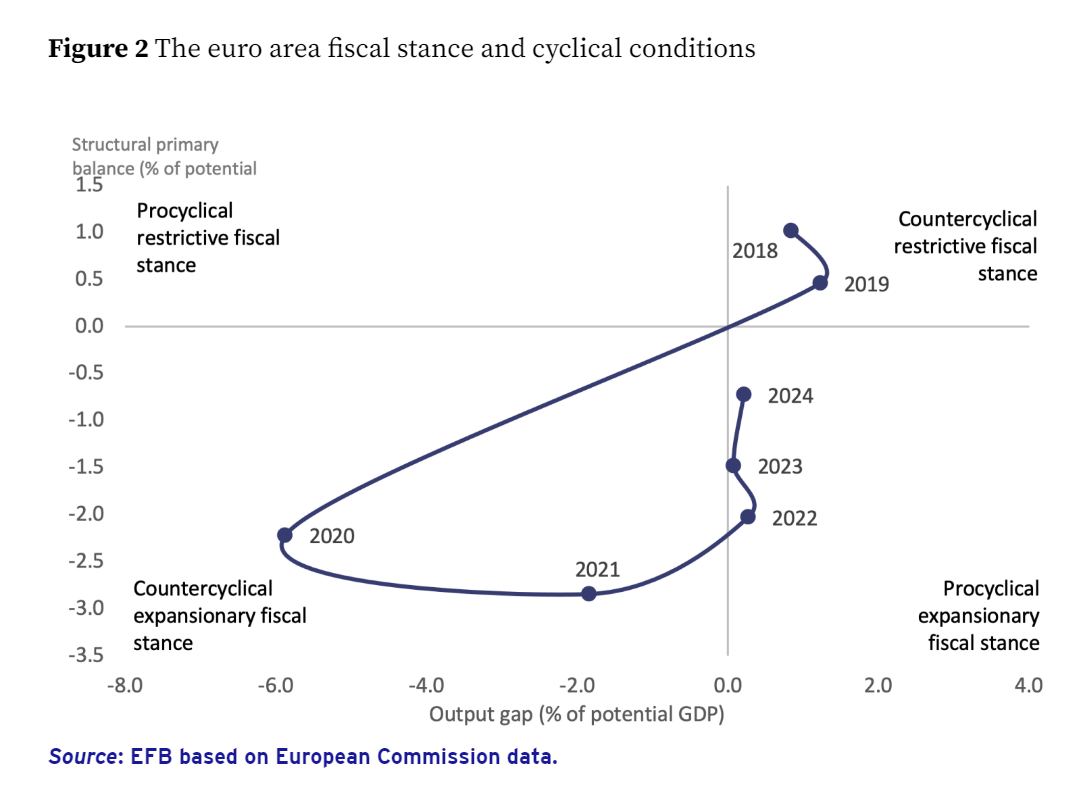
In this commentary, the authors argue that these “unconventional fiscal policy” measures have significantly increased debt ratios, especially those of countries with already high debt ratios to start with. Although high nominal economic growth has eased pressures on debt ratios for the time being, sovereign borrowing costs are also on the rise and their full effect will be felt with some lag. In particular, the structural primary deficit in 2023 is expected to remain close to 1.5% of GDP and including interest expenditures, the deficit is estimated to be above 3% of GDP. Their recommendation:
Overall, euro area fiscal policy is moving in the right direction. Record-high structural deficits are gradually coming down. However, they are projected to remain too high for comfort. Given the identified risks to sustainability of public finances in several very high-debt countries and continued high uncertainty on many fronts, it would be warranted to withdraw discretionary fiscal support at a swift pace, especially measures that were meant to be temporary, and use the economic good times to build fiscal buffers. This would also help the ECB in bringing inflation back to its target, while putting Member States in a position to deal with the rising costs of aging and climate change, as well as new challenges, such as rising interest payments and costs of defence.
Putting the fiscal toothpaste back into the tube: It’s time to normalise the euro area fiscal stance in 2024
By: Niels Thygesen Roel Beetsma Massimo Bordignon Xavier Debrun Mateusz Szczurek Martin Larch Matthias Busse Mateja Gabrijelcic Laszlo Jankovics Janis Malzubris – University Of Copenhagen, University Of Amsterdam, Catholic University Of Milan, National Bank of Belgium, European Fiscal Board
