Some general thoughts on the U.S. trade deficit
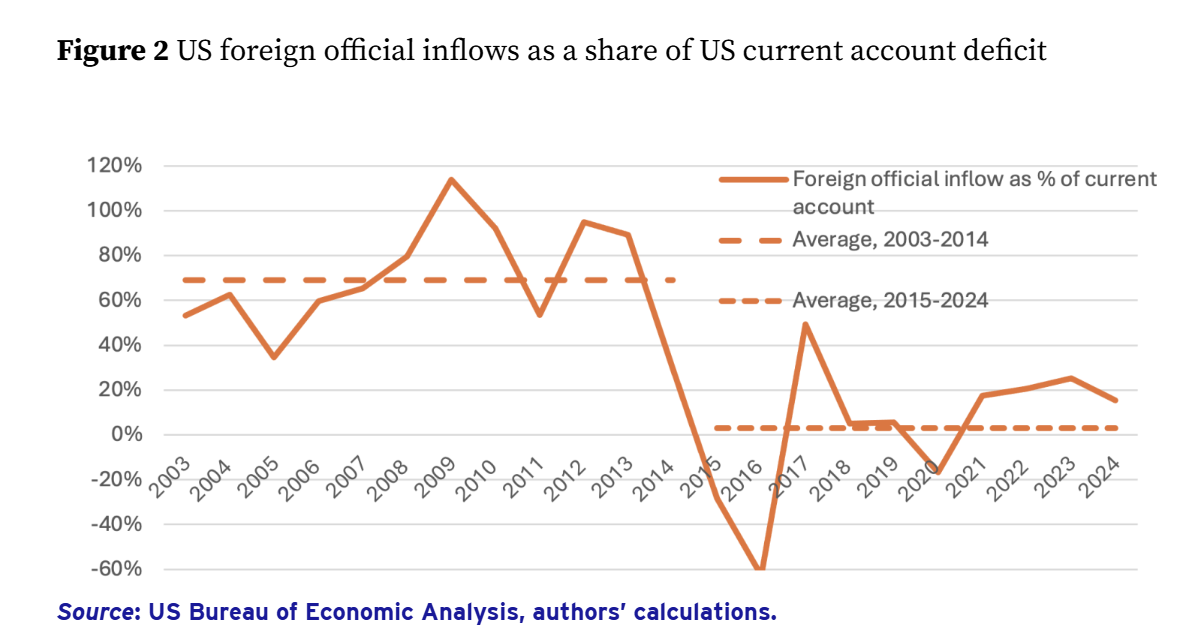
Michael Bordo (Rutgers University) and Robert N McCauley (Boston University) challenge the notion that the current international monetary system operates under a “Triffin dilemma,” where foreign central banks’ dollar accumulation forces U.S. trade deficits. While this dynamic held from 2003–2014 (with foreign officials financing two-thirds of U.S. deficits), post-2015 trends show collapsing foreign inflows into U.S. assets, a shrinking share of Treasury holdings by foreign officials, and a shift toward gold reserves. This indicates the Triffin framework no longer applies, as U.S. deficits are no longer driven by foreign dollar demand.
Michael R. Strain (Georgetown University), on the other hand, argues that prioritizing manufacturing jobs is misguided, as the sector’s long-term employment decline stems from productivity gains through automation, not trade. Protectionist measures from the first Trump administration, such as tariffs, backfired, reducing manufacturing jobs by raising input costs and triggering retaliatory tariffs, while Biden’s industrial policies face structural flaws like vague goals and high costs. Efforts to revive manufacturing ignore that middle-wage jobs now thrive in sectors like healthcare and tech, and trade deficits reflect macroeconomic factors, not policy failures. Instead of clinging to outdated sectors, the author advocates worker retraining, reducing regulatory barriers, and allied coordination to address strategic competition with China—policies that align with market dynamism rather than resisting it.
Miran, we’re not in Triffin land anymore
By: Michael Bordo, Robert N McCauley – Rutgers University, Boston University
Protectionism Is Failing and Wrongheaded: An Evaluation of the Post-2017 Shift toward Trade Wars and Industrial Policy
Author: Michael R. Strain
From: Georgetown University
The European reaction to the U.S. tariffs
Lorenzo Bini Smaghi (Bocconi University) argues that while the ECB might consider influencing exchange rates to mitigate economic impacts, this approach would be misguided. He emphasizes that the ECB should prioritize its core mandate of maintaining price stability rather than attempting to counteract trade policy measures through currency interventions. The piece underscores the risks of diverting from the ECB’s primary objectives in response to external political decisions.
André Wolf (CEP) analyzes the EU’s Anti-Coercion Instrument (ACI) as a potential response to Donald Trump’s 2025 20% tariffs on EU imports. While the ACI – created in 2023 to counter economic coercion like China’s pressure on Lithuania over Taiwan policy – allows countermeasures such as tariffs and trade restrictions, its applicability to the US tariffs is questioned. The author argues Trump’s measures aim to boost US industrial competitiveness rather than force specific EU policy changes, making them legally distinct from the coercion the ACI was designed to address.
A unilateral EU response via the ACI risks undermining multilateral trade norms and encouraging similar defensive measures by other countries against EU policies. Instead, André Wolf advocates for a coordinated international response with partners like Canada and Japan (who are disproportionately affected by Trump’s tariffs) and identifies opportunities for US-EU cooperation on liquefied natural gas (LNG) contracts and critical mineral partnerships to reduce reliance on China.
Robert Basedow (LSE) argues the EU and UK should respond through diplomacy (targeted retaliation, sectoral deals), third-country partnerships (trade agreements with Mercosur, India, etc.), and domestic reforms (capital markets integration, industrial policy alignment) to mitigate economic damage and reduce reliance on U.S. markets.
The ECB’s Choices in the Face of Trump’s Tariffs
By: Lorenzo Bini Smaghi – Bocconi University
Is the EU’s Anti-Coercion Instrument a credible weapon against US tariffs?
By: André Wolf – Centre for European Policy (CEP), Berlin
How the EU and UK should respond to Trump’s Liberation Day tariffs
By: Robert Basedow – LSE
Potential impact of U.S. tariffs
Germany
Lisandra Flach (Ifo Institute), Lisa Scheckenhofer (Ifo Institute) argue that the proposed US “reciprocal” tariffs—which aim to match tariffs imposed by trade partners—could reduce German exports to the US by 2.4–3.0% and slightly decrease German value added by 0.02%. This impact stems from the 0.5 percentage point average tariff gap between the US and EU, affecting 53% of Germany’s exports to the US (6% of its global exports). While most affected products would face modest tariff increases (75% have gaps below 2.3 percentage points), sectors like motor vehicles and transport equipment face disproportionate losses due to higher sector-specific tariff gaps (e.g., 3.7–4.4 percentage points). The authors add that retaliation scenarios will harm German exports, particularly in manufacturing and agriculture, while creating limited trade diversion benefits within the EU.
Canada and Mexico
Lisandra Flach (Ifo Institute) and Andreas Baur (Ifo Institute) analyze the economic consequences of 25% tariffs on Canadian and Mexican imports using the Ifo Trade Model. Without retaliation, Canadian and Mexican exports would decline by 17% and 21%, respectively, while U.S. exports would drop 14%. If Canada and Mexico retaliate symmetrically, export losses escalate to 28% (Canada), 35% (Mexico), and 22% (U.S.), reflecting deep North American supply chain integration. Sectorally, Canada’s manufacturing faces a 14% value-added loss, Mexico’s 13%, and U.S. agriculture declines by 2.39%. Retaliation worsens losses in Canadian agriculture/mining (6.7%) and amplifies Mexican industrial declines. The study underscores geographic and economic reliance on U.S. markets, urging Canada and Mexico to diversify trade partnerships to mitigate risks from tariff escalations.
China
George Magnus (Oxford University) argues that President Trump’s aggressive tariff strategy—featuring new 34% duties and plans to raise existing levies by 50%—has prompted a multi-pronged counteroffensive from China. Beijing initially responded by matching U.S. tariffs with reciprocal 34% penalties on American goods, while state media warned of potential export restrictions on rare earth minerals critical to technology and defense sectors. Simultaneously, China is accelerating domestic reforms to reduce export dependency, including fiscal stimulus programs and currency stabilization measures to boost internal consumption. Additionally, authorities are preparing targeted retaliatory tools such as export bans on dual-use technologies and blacklisting U.S. firms operating in China. Diplomatically, Beijing has frozen high-level trade talks and intervened in financial markets to mitigate volatility caused by the escalating conflict. Analysts project these measures could shrink China’s GDP growth by 1–2 percentage points in 2025, with both economies now bracing for broader disruptions across global supply chains as tariff rates on Chinese imports threaten to surpass 100%.
US “Reciprocal” Tariffs and the Erosion of Global Trade Rules: Implications for Germany
Authors: Lisandra Flach, Lisa Scheckenhofer
From: Ifo Institute
The Effect of Trump Tariffs on Mexico and Canada
Authors: Lisandra Flach, Andreas Baur
From: Ifo Institute
How Trump’s tariffs will hurt China
By: George Magnus, Oxford University


