


Political polarization in corporations
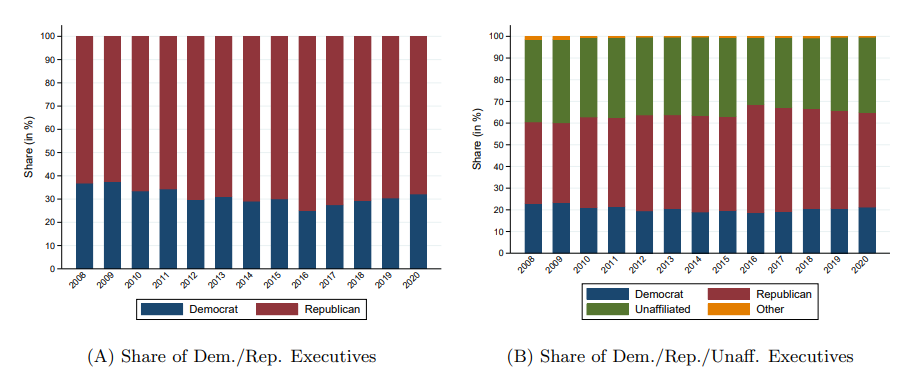
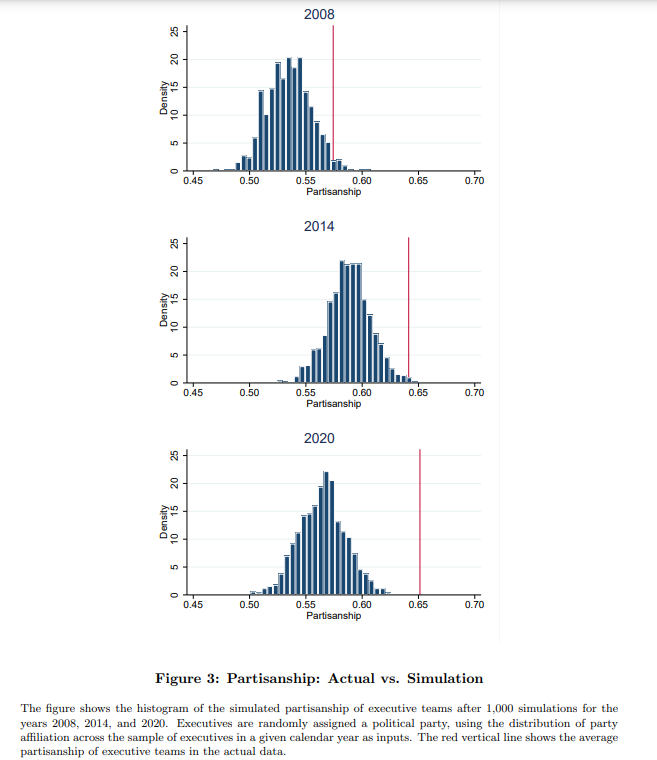
In this paper, Fos et al. study political polarization among corporate decision-makers. Recent research has found that that political partisanship shapes the perception of the economy and economic decisions not only by households, but also by economically sophisticated agents in high-stakes environments. Therefore, political polarization in executive teams may have important implications for firm value. The authors use data on political affiliations from voter registration records for top executives of S&P 1500 firms. They find that executives became more partisan between 2008 and 2020 despite the fact that executive teams had become more diverse along the gender dimension , which should have, if anything, led to greater diversity in political views. In particular they find that:
- 61% of the increase in partisanship is driven by an increased tendency of executives to match with other executives who share their political views. The remaining 39% is driven by the executive population as a whole becoming more politically homogeneous (i.e., Republican).
- Within a given firm-year, executives who are politically misaligned with the majority of the team have a 3.2-percentage-point-higher probability of leaving the firm than executives whose views are not aligned with the rest of the team.
Is this increase in partisanship good for shareholders?
[W]e study abnormal stock returns around the departures of politically aligned and misaligned executives. Departures of misaligned executives trigger substantially larger losses for shareholders, indicating greater political homogeneity in the executive suite is likely not in the interest of shareholders. The incremental losses to shareholders around executive departures amount to $238 million for executives who are politically misaligned. We also find evidence that departures of misaligned CEOs are more likely to be involuntary.
The Political Polarization of Corporate America
Authors: Vyacheslav Fos, Elisabeth Kempf, Margarita Tsoutsoura
From: Boston College, University of Chicago, Cornell University
Political polarization and international capital flows
Kempf et al., in this paper, examine whether political alignment with foreign governments affects how optimistic investors are about the local economy. In particular, they look at investment decisions of US banks and international mutual fund managers around foreign elections that induce changes in investors’ political alignment with the party in power.
The authors obtained data on cross-border syndicated corporate loans from the DealScan database, maintained by the Loan Pricing Corporation. Their sample covers 83 percent of the aggregate cross-border lending volume by US banks between 2000 and 2018. To identify the political leaning of banks, they use contributions from political action committees and individuals, as compiled by the nonprofit Center for Responsive Politics (now OpenSecrets). For US-based mutual funds with a mandate to invest internationally, they obtain semi-annual fund holdings information from the FactSet International Ownership database, spanning years 2000 to 2018. To measure the political ideology of the fund management team, they link individual fund managers to party affiliations in voter registration records that they obtained for nine US states. To measure the ideological distance between their sample of US investors and elected foreign parties, they draw on the Manifesto Project Dataset, which analyzes the manifestos of 1,000 political parties in more than 50 countries and allows them to score these parties on the left-right political spectrum.
Taken together, our results portray a compelling picture of partisan perception transcending national borders and shaping cross-border investments. The economic effects of partisan perception are thus much broader than previously thought. Our results also imply ideological alignment is an important, omitted factor in models of international capital flows and provide a new perspective on the macroeconomic risk of political election outcomes. In particular, our results suggest that even elections of fairly moderate political parties can trigger large changes in capital flows, depending on the ideology of the investor.


Does Political Partisanship Cross Borders? Evidence from International Capital Flows
Authors: Elisabeth Kempf, Mancy Luo, Larissa Schäfer, Margarita Tsoutsoura
From: University of Chicago, Erasmus University, Frankfurt School of
Finance & Management, Cornell University
