


Has regulatory policy increased concentration in the banking industry in the US?
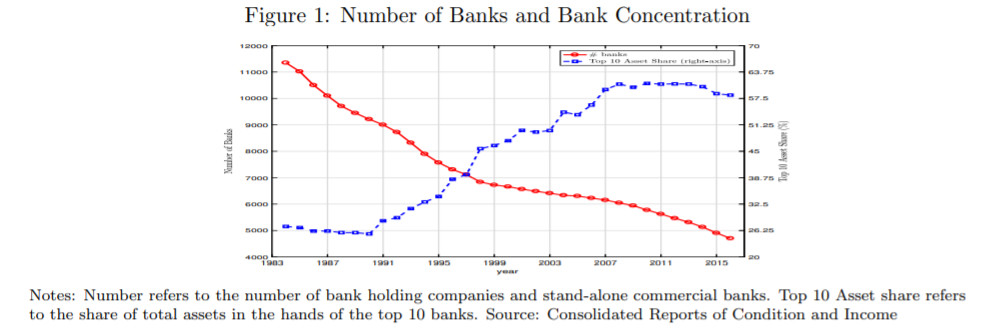
The U.S. banking industry appears highly concentrated with the top 10 banks now comprising nearly 60% of the market share while the remaining nearly 5000 banks comprise a little over 40%.
In this paper, Corbae et al. analyze the interaction between regulatory policy and the market structure of the banking sector. In particular, they study the effect of a rise in level of capital requirements from 4% under Basel II to 8.5% motivated by changes recommended by Basel III. They find that such a rise in capital requirements:
- Decreases the long run exit rates of small banks but also leads to a more concentrated industry since it inhibits entry;
- In the short run, big banks decide to strategically gain loan market share financed by issuing more equity, cutting dividends, and retaining more earnings. The net effect of higher big bank lending and lower small bank lending is a decrease in total bank lending of over 7% in the short run and nearly 9% in the long run but only a modest rise in interest rates on loans in the long run.
Capital Buffers in a Quantitative Model of Banking Industry Dynamics
Authors: Dean Corbae, Pablo D’Erasmo
From: University of Wisconsin – Madison, Federal Reserve Bank of Philadelphia
