• Twitter
  • Search
e-axes

360° Econ View

The issues, the debates, and the research

  • Home
  • Useful Data
  • About
  • Contact
  • Home
  • Useful Data
  • About
  • Contact

Financial Markets

Negative interest rates and bank lending

Posted by e-axes on March 2, 2022

Read Next →

Financial Markets

When Markets Drift from the Real Economy

Financial Markets

Gold, the Dollar, and the Geopolitics of Global Reserves

Financial Markets

From Information to Liquidity: How Stablecoins Reshape Bank Intermediation

The long-term impact of negative interest rates on bank lending

In this paper, Arce et al. study the effect of the ECB’s negative deposit facility rate on the supply of credit by Spanish banks to non-financial corporations from 2014 to 2019. Their emphasis on the longer time period enables them to look at the effect of negative rates over a prolonged period of time. They build a unique dataset consisting of loans granted to Spanish firms from the Credit Register of the Bank of Spain, banks’ and firms’ balance sheets and confidential survey data from the ECB’s Bank Lending Survey (BLS). They find:

  • Banks adversely affected by the negative interest rates curtailed
    their lending supply to firms (relative to non-affected banks) only during the last sub-sample period (2018-2019), while there is no effect during earlier periods;
  • Banks with low capital ratios contract their lending supply  first to risky firms prior to restricting it to safe firms and by a greater magnitude;
  • Lower supply of credit by affected low-capitalized banks seems to be offset by the higher lending supply from non-affected banks which have the capacity for taking additional risks.
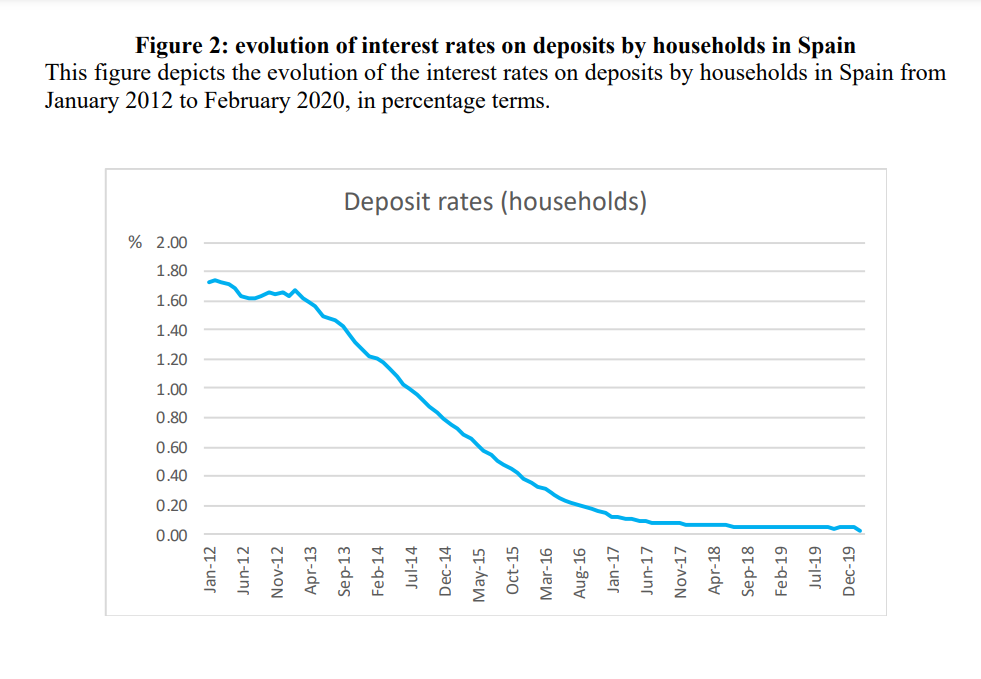

Adapting lending policies in a “negative-for-long” scenario
Authors: Oscar Arce, Miguel Garcia-Posada, Sergio Mayordomo, Steven Ongena
From: Banco de España, University of Zurich

A more granular look that leads to different results

In this paper, Romina Ruprecht develops a dynamic general equilibrium model, where banks provide credit to firms with heterogeneous investment opportunities in an excess reserve environment. In this model lending rates depend proportionally on the marginal product of capital, the bargaining power of banks and the money market rate. Ruprecht’s model indicates that:

  • Unconstrained banks have to offer a lower lending rate to compensate for the higher loan sizes, while constrained banks can increase lending rates because highly productive firms want to borrow as much possible and are willing to pay a higher price for the loan.
  • The effect on the individual lending rates and the compositional effect imply that the dispersion of lending rates increases with a decrease in the interest rate on excess reserves.
  •  The overall effect on average lending rates depends on the relative size of the effect on constrained banks, the effect on unconstrained banks and the compositional effect.
  • Ruprecht’s conclusion, is in contrast to Arce et al. above:

I find that a decrease in the policy rates leads to decreasing aggregate bank lending, increasing lending rates and a higher dispersion of lending rates. Recent observations of lending rates in Switzerland, Sweden and Italy provide some support for this theoretical finding.

Negative Interest Rates and Bank Lending Rates
Author: Romina Ruprecht
From: Federal Reserve Board

Print Friendly, PDF & Email

e-axes

Read Next →

Financial Markets

When Markets Drift from the Real Economy

Financial Markets

Gold, the Dollar, and the Geopolitics of Global Reserves

Financial Markets

From Information to Liquidity: How Stablecoins Reshape Bank Intermediation

Comments are Closed

Account

  • Login

Subscriptions

You are not logged in.
Login
Subscribe

Subscriptions

Subscribe

Most Read

  • Public Debt Maturity and Macroeconomic Policy Transmission
  • Bank Heterogeneity and the Transmission of Monetary Tightening
  • AI Valuations, Capital Investment, and Growth
  • New and Noteworthy Books in Economics (September)
  • AI and the Natural Rate: Puzzle or Policy Challenge?
  • Macroeconomic Risk: From Scenario Synthesis to Distributional Transmission
  • Communicating Uncertainty: Fan Charts, Confidence, and Credibility
  • Transfers, Taxes, and the Ricardian Equivalence
  • Can Institutions Limit the Economic Damage of Populism?
  • Asia’s Expanding Non-Dollar Payment Networks

Sections

  • AI
  • Banking
  • Books
  • Brexit
  • CBDC
  • China
  • Climate
  • COVID-19
  • Crypto
  • Demographics
  • Economic Growth
  • Economic Science
  • Economics of Information
  • Emerging Markets
  • Eurozone
  • Financial Markets
  • Geoeconomics
  • Geopolitics
  • India
  • Inequality
  • Inflation
  • International Economics
  • Macro
  • Markets
  • Monetary Policy
  • Oil
  • Politics & Economics
  • Taxation
  • Tech
  • Trade
  • U.S.
  • Ukraine-Russia War
  • Uncategorized
  • Useful Data

© 2026 e-axes

  • Privacy Policy & Terms of Service

Theme by Anders Norén

This website uses cookies to improve your experience. We'll assume you're ok with this, but you can opt-out if you wish.
Cookie settingsAccept
Privacy & Cookies Policy

Privacy Overview

This website uses cookies to improve your experience while you navigate through the website. Out of these cookies, the cookies that are categorized as necessary are stored on your browser as they are as essential for the working of basic functionalities of the website. We also use third-party cookies that help us analyze and understand how you use this website. These cookies will be stored in your browser only with your consent. You also have the option to opt-out of these cookies. But opting out of some of these cookies may have an effect on your browsing experience.
Necessary
Always Enabled
Necessary cookies are absolutely essential for the website to function properly. This category only includes cookies that ensures basic functionalities and security features of the website. These cookies do not store any personal information.
SAVE & ACCEPT