• Twitter
  • Search
e-axes

360° Econ View

The issues, the debates, and the research

  • Home
  • Useful Data
  • About
  • Contact
  • Home
  • Useful Data
  • About
  • Contact

COVID-19

How to control aggregate demand during the pandemic

Posted by e-axes on April 7, 2020

Read Next →

COVID-19

Navigating ESG Reputational Risks

COVID-19

Policy lessons from the pandemic

COVID-19

The economics of vaccines

Fiscal policy vs monetary policy

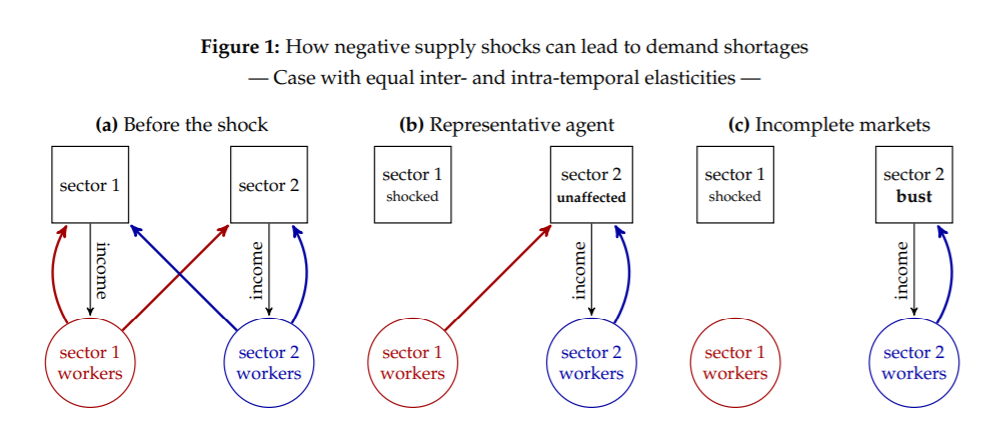
Guerrieri and al. in this paper are trying to answer two questions:

  • Can a shock to supply, such as those experienced during a pandemic, lead to deficient demand?
  • What are the combination of policy tools, monetary and fiscal, that best address this question?

They find that demand may indeed overreact to the supply shock and lead to a demand-deficient recession. Two conditions can give rise to such an effect, namely, low substitutability across sectors and incomplete markets, with liquidity constrained consumers.  In that case various forms of fiscal policy, per dollar spent, may be less effective in this model. Monetary policy, as long as it is unimpeded by the zero lower bound, can have magnified effects, by preventing firm exits.

Despite this, the optimal policy to face a pandemic in this model combines as loosening of monetary policy as well as abundant social insurance.
Macroeconomic Implications of COVID-19: Can Negative Supply Shocks Cause Demand Shortages?
Authors: Veronica Guerrieri, Guido Lorenzoni, Ludwig Straub, Iván Werning
From: University of Chicago, Northwestern University, Harvard University, MIT

The effectiveness of different fiscal policies

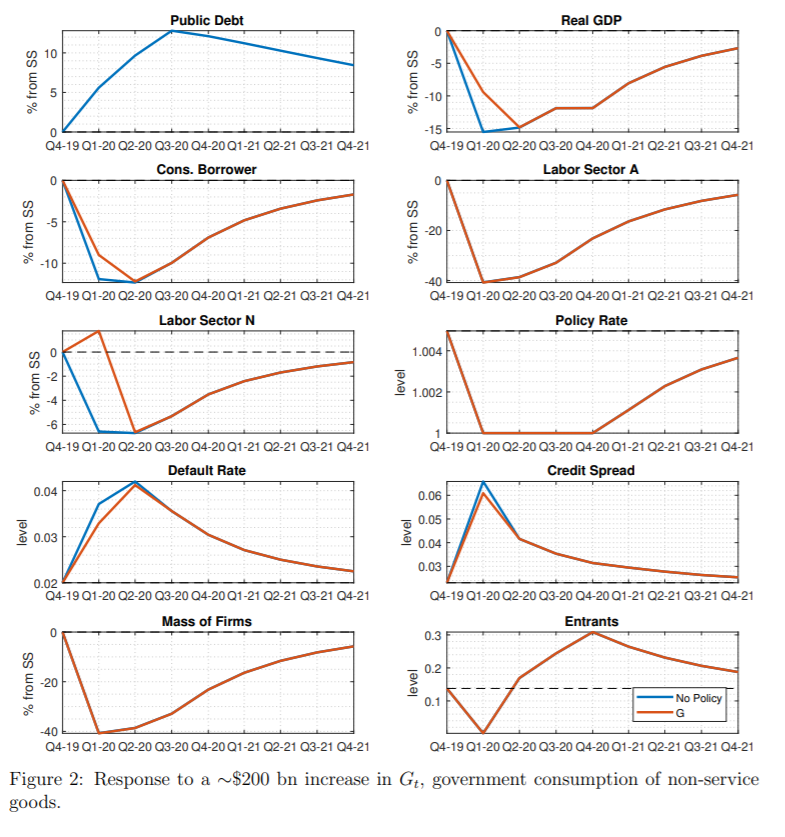
Miguel Faria e Castro uses a nonlinear DSGE model, where the pandemic is modeled as a negative shock to the utility of consumption,  to analyze the effectiveness of different fiscal policies in mitigating the economic impact of the coronavirus outbreak. He finds that:

  • Liquidity assistance to firms has the longest-lasting effects and can be very effective in terms of stabilizing employment in the medium-run;
  • Unemployment Insurance benefits are the most effective tool to stabilize income for borrowers, who are the hardest hit;
  • Income tax cuts and unconditional transfers are also effective, but generate lower multipliers as they are less well targeted to agents with lower income;
  • There are implementation lags that can be made worse by attempts to better target policies. Better targeted policies may additionally entail extra costs associated with bureaucracy. It may sometimes be better to undertake a slightly worse policy whose implementation requires less information and time, i.e. unconditional transfers vs. expansion of unemployment insurance eligibility.

Fiscal Policy during a Pandemic
Author: Miguel Faria e Castro
From: Federal Reserve Bank of St. Louis

Print Friendly, PDF & Email

e-axes

Read Next →

COVID-19

Navigating ESG Reputational Risks

COVID-19

Policy lessons from the pandemic

COVID-19

The economics of vaccines

Comments are Closed

Account

  • Login

Subscriptions

You are not logged in.
Login
Subscribe

Subscriptions

Subscribe

Most Read

  • Bank Heterogeneity and the Transmission of Monetary Tightening
  • Central Bank Losses and Public Debt: Constraints on Inflation Control
  • AI Valuations, Capital Investment, and Growth
  • How Firms’ Cost Expectations Shape Prices
  • Communicating Uncertainty: Fan Charts, Confidence, and Credibility
  • The AI Infrastructure Boom: Productive Investment or Financial Fragility?
  • Macroeconomic Risk: From Scenario Synthesis to Distributional Transmission
  • Measuring Expectations in Real Time: The Value and Limits of Kalshi Markets
  • Measuring Global Tensions Using AI
  • When Markets Drift from the Real Economy

Sections

  • AI
  • Banking
  • Books
  • Brexit
  • CBDC
  • China
  • Climate
  • COVID-19
  • Crypto
  • Demographics
  • Economic Growth
  • Economic Science
  • Economics of Information
  • Emerging Markets
  • Eurozone
  • Financial Markets
  • Geoeconomics
  • Geopolitics
  • India
  • Inequality
  • Inflation
  • International Economics
  • Macro
  • Markets
  • Monetary Policy
  • Oil
  • Politics & Economics
  • Taxation
  • Tech
  • Trade
  • U.S.
  • Ukraine-Russia War
  • Uncategorized
  • Useful Data

© 2026 e-axes

  • Privacy Policy & Terms of Service

Theme by Anders Norén

This website uses cookies to improve your experience. We'll assume you're ok with this, but you can opt-out if you wish.
Cookie settingsAccept
Privacy & Cookies Policy

Privacy Overview

This website uses cookies to improve your experience while you navigate through the website. Out of these cookies, the cookies that are categorized as necessary are stored on your browser as they are as essential for the working of basic functionalities of the website. We also use third-party cookies that help us analyze and understand how you use this website. These cookies will be stored in your browser only with your consent. You also have the option to opt-out of these cookies. But opting out of some of these cookies may have an effect on your browsing experience.
Necessary
Always Enabled
Necessary cookies are absolutely essential for the website to function properly. This category only includes cookies that ensures basic functionalities and security features of the website. These cookies do not store any personal information.
SAVE & ACCEPT