• Twitter
  • Search
e-axes

360° Econ View

The issues, the debates, and the research

  • Home
  • Useful Data
  • About
  • Contact
  • Home
  • Useful Data
  • About
  • Contact

Climate

Green spending and fiscal sustainability

Posted by e-axes on January 25, 2024

Read Next →

Climate

Is Economic Growth Compatible With Credible Climate Constraints?

Climate

Can Financial Markets and Economic Literacy Reshape the Politics of Climate? Action

Climate

The Cost of Inconsistent and Incredible Climate Policy

A global climate-fiscal policy

In this paper, Ruud de Mooij and Vitor Gaspar, explore the fiscal implications for countries of global climate mitigation in the medium term. The authors propose a “policy scenario of global carbon mitigation, which includes both coordinated carbon pricing, other mitigation policies, compensation schemes, and a revenue sharing mechanism that breaches the financial divide between rich and poor countries. The scenario is designed to achieve a path toward 2°C above pre-industrial temperatures, as agreed in Paris in 2015.” The main assumptions of their suggested policies include:

  • An eighty percent reduction of 2023 gross emission levels by 2050 for advanced economies and by 2060 for emerging market economies, with the assumption that carbon capture and storage will offset the remaining emissions.
  • For a representative advanced economy, the policy includes a carbon price that increases from $40 a ton today to $130 by 2030 and $235 by 2050. Revenues from carbon pricing could peak around 2030 as decarbonization will gradually erode the carbon tax base.
  • Thirty percent of the carbon revenues are used to compensate households through cash transfers. On the expenditure side, green public investment and green subsidies increase to around ½ percent of GDP.
  • Climate-related fiscal spending under this policy scenario will increase the debt-to-GDP ratio of an advanced country by less than ten percentage points.
  • A global side agreement on carbon mitigation for developing economies should be put in place. It assumes that high- and upper-middle-income countries agree to reduce their emissions in 2030 by 49 percent and 26 percent, respectively, below 2019 levels. Low-income and lower-middle-income countries would still be able to grow their emissions by 6 percent relative to 2019, but this is less than implied by current mitigation pledges .

This climate-fiscal policy relying on carbon pricing could have moderately positive to moderately negative impacts on fiscal balances in high-income countries. For example, while global decarbonization will have negative fiscal implications for most European countries, effects can be positive for the US and Japan if public spending is contained. However such policy will generally have positive and significant net fiscal impacts on middle and low-income countries.
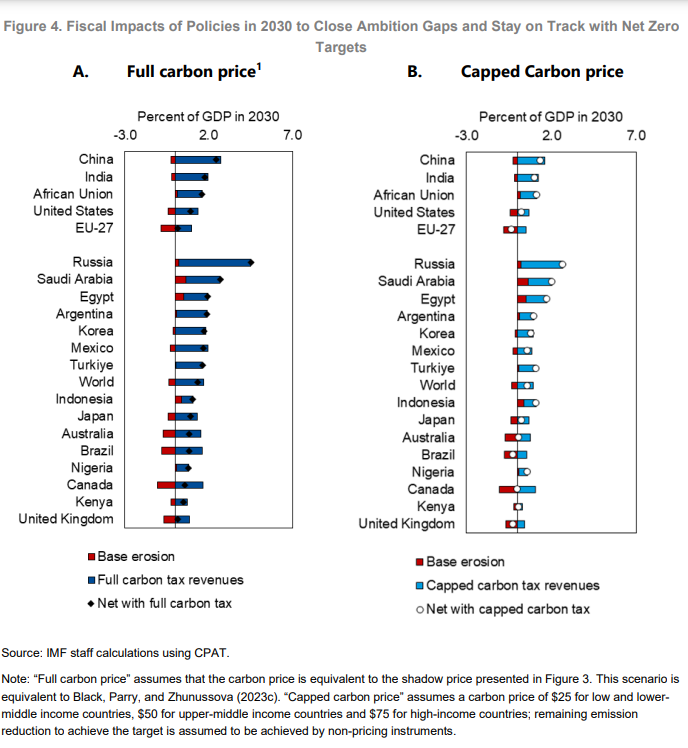
While political-economy considerations are critical for the design and implementation of carbon mitigation policies, political red lines might be relaxed through carefully designed policy packages (including compensation measures and clear communication) and through international coordination.

How does decarbonization change the fiscal equation?
Authors: Ruud de Mooij, Vítor Gaspar
From: IMF

Slow green spending and slow fiscal adjustment

In this commentary, Olivier Blanchard discusses the challenge advanced economies face of balancing the need for green spending to address climate change with the imperative of maintaining debt sustainability. His suggestions include:

  • The assessment of fiscal sustainability using a stochastic debt sustainability analysis that includes “all revenues and all spending, green or not. If green spending leads to higher debt, that debt must be financed, no matter what essential function the debt was used for. In other words, green spending does not get a debt pass.”
  • Blanchard cautions that green public investment will not lead to higher government revenues. “If anything, the transition to green energy is likely to decrease growth, at least for some time. And the transition may further decrease revenues.”
  • The best strategy is for green spending to be spread over a longer period coupled with a slower fiscal adjustment which will imply a smaller increase in the debt ratio for some time. Carbon taxes and fees will limit the fiscal impact as compared to subsidies.

Reconciling the tension between green spending and debt sustainability
By: Olivier Blanchard, PIIE

Print Friendly, PDF & Email

e-axes

Read Next →

Climate

Is Economic Growth Compatible With Credible Climate Constraints?

Climate

Can Financial Markets and Economic Literacy Reshape the Politics of Climate? Action

Climate

The Cost of Inconsistent and Incredible Climate Policy

Comments are Closed

Account

  • Login

Subscriptions

You are not logged in.
Login
Subscribe

Subscriptions

Subscribe

Most Read

  • Gold, the Dollar, and the Geopolitics of Global Reserves
  • China and the Political Economy of Critical Minerals
  • Public Debt Maturity and Macroeconomic Policy Transmission
  • Bank Heterogeneity and the Transmission of Monetary Tightening
  • AI, Knowledge and the Future of Human Expertise
  • AI Valuations, Capital Investment, and Growth
  • New and Noteworthy Books in Economics (September)
  • AI and the Natural Rate: Puzzle or Policy Challenge?
  • Transfers, Taxes, and the Ricardian Equivalence
  • Can Institutions Limit the Economic Damage of Populism?

Sections

  • AI
  • Banking
  • Books
  • Brexit
  • CBDC
  • China
  • Climate
  • COVID-19
  • Crypto
  • Demographics
  • Economic Growth
  • Economic Science
  • Economics of Information
  • Emerging Markets
  • Eurozone
  • Financial Markets
  • Geoeconomics
  • Geopolitics
  • India
  • Inequality
  • Inflation
  • International Economics
  • Macro
  • Markets
  • Monetary Policy
  • Oil
  • Politics & Economics
  • Taxation
  • Tech
  • Trade
  • U.S.
  • Ukraine-Russia War
  • Uncategorized
  • Useful Data

© 2026 e-axes

  • Privacy Policy & Terms of Service

Theme by Anders Norén

This website uses cookies to improve your experience. We'll assume you're ok with this, but you can opt-out if you wish.
Cookie settingsAccept
Privacy & Cookies Policy

Privacy Overview

This website uses cookies to improve your experience while you navigate through the website. Out of these cookies, the cookies that are categorized as necessary are stored on your browser as they are as essential for the working of basic functionalities of the website. We also use third-party cookies that help us analyze and understand how you use this website. These cookies will be stored in your browser only with your consent. You also have the option to opt-out of these cookies. But opting out of some of these cookies may have an effect on your browsing experience.
Necessary
Always Enabled
Necessary cookies are absolutely essential for the website to function properly. This category only includes cookies that ensures basic functionalities and security features of the website. These cookies do not store any personal information.
SAVE & ACCEPT