• Twitter
  • Search
e-axes

360° Econ View

The issues, the debates, and the research

  • Home
  • Useful Data
  • About
  • Contact
  • Home
  • Useful Data
  • About
  • Contact

Geopolitics

Geopolitical Hybrid Threats and their Impact on the Macroeconomy

Posted by e-axes on March 31, 2026

Read Next →

Geoeconomics

Geopolitics, Geoeconomics, and Sovereign Risk

Geopolitics

The Rising Fragmentation of Global Science

Geopolitics

Geopolitics Driving Innovation and Competitive Sabotage

Measuring and pricing geopolitical hybrid risk

In this working paper, Norbert Metiu and Martin Völpel construct a novel index of geopolitical hybrid threats and examine their macroeconomic consequences using structural time-series analysis.

The authors build a Geopolitical Hybrid Threat (GHT) index using textual analysis of approximately 12.7 million articles from ten leading English-language newspapers including the Financial Times, New York Times, and Wall Street Journal from January 1985 to June 2025. The index tracks the monthly frequency of newspaper articles containing search terms across five categories of hybrid threats: Warfare, Espionage, Sabotage, Coercion, and Disinformation. The share of articles referencing hybrid threat terms is normalized to a mean of 100 over the full sample period. Finally, to assess macroeconomic impact, the authors estimate a structural proxy VAR with eight variables (GHT index, real investment, hours worked, GDP deflator, two-year Treasury yield, VIX, real S&P 500, and real oil price) using quarterly U.S. data from 1986Q1 to 2025Q2.

Findings

Historical trends in the GHT Index: The composition of threats has shifted markedly: while Warfare and Coercion dominated coverage in earlier decades, Disinformation and Sabotage now account for over one-third of articles in the 2020s, reflecting the growing prominence of cyberattacks and information operations.

Macroeconomic impact: An exogenous 40% increase in the GHT index, equivalent to the surge observed at the start of Russia’s 2022 invasion of Ukraine, generates effects akin to a negative aggregate demand shock:

  • Investment falls by approximately 6.2% at its trough (after four quarters)
  • Hours worked decline by about 1.6% (after five quarters)
  • Real S&P 500 drops by roughly 7.0% (three quarters after impact)
  • The GDP deflator falls by nearly 1%, and oil prices by about 11.9%
  • Both variables gradually return to baseline within four years

This demand-side pattern contrasts with the supply-side effects typically found for conventional geopolitical risk shocks, which raise prices rather than suppressing them.

Transmission channels: Metiu and Völpel identify three main propagation mechanisms:

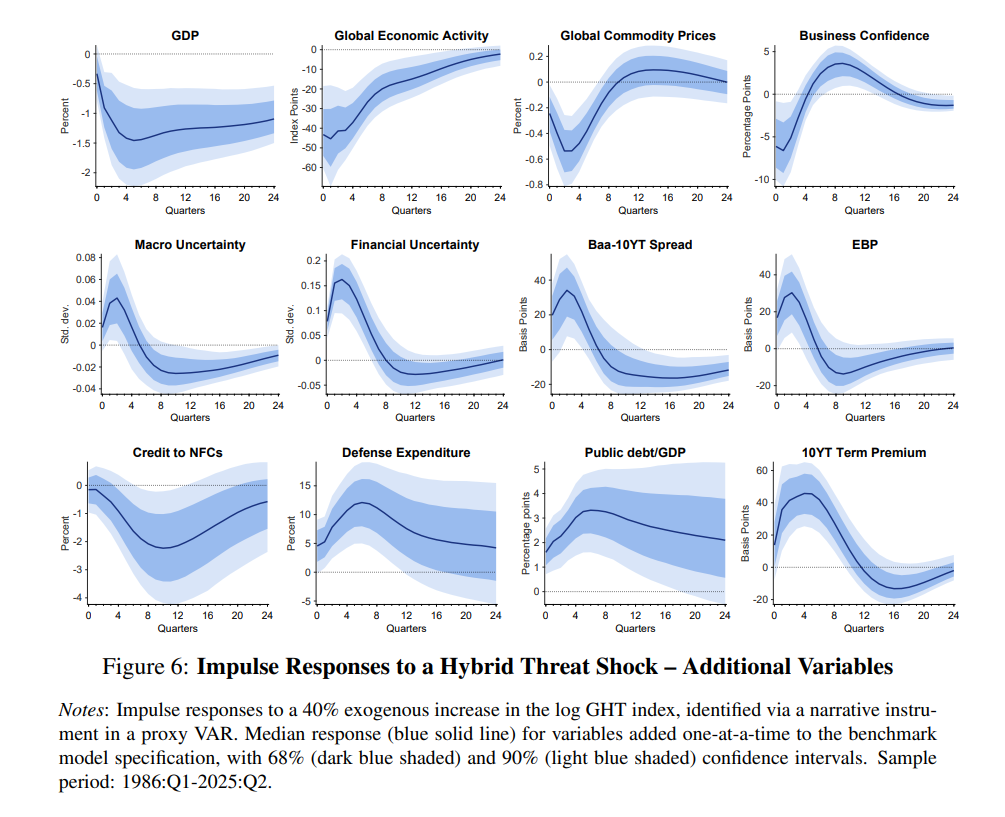
  1. Uncertainty and confidence: Business confidence deteriorates on impact, while macroeconomic and financial uncertainty rise significantly, prompting greater caution among firms and households.
  2. Financial conditions: Credit spreads and the excess bond premium widen, raising firms’ external financing costs and further depressing investment and credit to non-financial corporations.
  3. Policy responses: Monetary policy eases (the federal funds rate declines in the first two years), while defense spending rises significantly and persistently, financed by growing public debt, and accompanied by an increase in the 10-year Treasury term premium.

On balance, the contractionary demand effects outweigh the stimulative impact of these policy responses.

Geopolitical Hybrid Threats
Authors: Norbert Metiu, Martin Völpel
From: Deutsche Bundesbank

Beyond sanctions: A research agenda for geoeconomics and war

This paper by Eoin McGuirk and Christoph Trebesch is a structured literature review combined with a conceptual framework and research agenda. It synthesizes findings from political economy, international trade, conflict economics, and international relations, drawing on a wide body of empirical and theoretical work. The authors organize existing research around two pillars: (1) the relationship between trade and war, and (2) the classic geoeconomic tools namely aid, sanctions, embargoes, trade agreements, tariffs, export controls. They then identify four thematic gaps for future research:

  1. Broadening the geoeconomic toolkit beyond purely economic tools to include sabotage, cyberattacks, covert operations, proxy forces, and support for terrorism — the tools increasingly used by “rogue” or unconstrained leaders.
  2. Conflict escalation risk: whether geoeconomic tools substitute for or complement armed conflict, and under what conditions they deter versus provoke war.
  3. Domestic political economy: how leaders’ survival incentives, audience costs, and political agency frictions shape the choice and deployment of geoeconomic instruments.
  4. Explicit peacemaking tools: mediation, security guarantees, peacekeeping, and transparency initiatives as under-studied mechanisms that directly address bargaining failures.

Geoeconomics and Conflict: A Review and Open Questions
Authors: Eoin McGuirk, Christoph Trebesch
From: Tufts University, Kiel Institute

A map of geopolitical risks to EU in 2026


Global Risks to the EU 2026
Author: Veronica Anghel
From: European University Institute

Print Friendly, PDF & Email

e-axes

Read Next →

Geoeconomics

Geopolitics, Geoeconomics, and Sovereign Risk

Geopolitics

The Rising Fragmentation of Global Science

Geopolitics

Geopolitics Driving Innovation and Competitive Sabotage

Comments are Closed

Account

  • Login

Subscriptions

You are not logged in.
Login
Subscribe

Subscriptions

Subscribe

Most Read

  • Bank Heterogeneity and the Transmission of Monetary Tightening
  • AI Valuations, Capital Investment, and Growth
  • New and Noteworthy Books in Economics (September)
  • AI and the Natural Rate: Puzzle or Policy Challenge?
  • Communicating Uncertainty: Fan Charts, Confidence, and Credibility
  • How Firms’ Cost Expectations Shape Prices
  • Macroeconomic Risk: From Scenario Synthesis to Distributional Transmission
  • Measuring Expectations in Real Time: The Value and Limits of Kalshi Markets
  • Asia’s Expanding Non-Dollar Payment Networks
  • When Markets Drift from the Real Economy

Sections

  • AI
  • Banking
  • Books
  • Brexit
  • CBDC
  • China
  • Climate
  • COVID-19
  • Crypto
  • Demographics
  • Economic Growth
  • Economic Science
  • Economics of Information
  • Emerging Markets
  • Eurozone
  • Financial Markets
  • Geoeconomics
  • Geopolitics
  • India
  • Inequality
  • Inflation
  • International Economics
  • Macro
  • Markets
  • Monetary Policy
  • Oil
  • Politics & Economics
  • Taxation
  • Tech
  • Trade
  • U.S.
  • Ukraine-Russia War
  • Uncategorized
  • Useful Data

© 2026 e-axes

  • Privacy Policy & Terms of Service

Theme by Anders Norén

This website uses cookies to improve your experience. We'll assume you're ok with this, but you can opt-out if you wish.
Cookie settingsAccept
Privacy & Cookies Policy

Privacy Overview

This website uses cookies to improve your experience while you navigate through the website. Out of these cookies, the cookies that are categorized as necessary are stored on your browser as they are as essential for the working of basic functionalities of the website. We also use third-party cookies that help us analyze and understand how you use this website. These cookies will be stored in your browser only with your consent. You also have the option to opt-out of these cookies. But opting out of some of these cookies may have an effect on your browsing experience.
Necessary
Always Enabled
Necessary cookies are absolutely essential for the website to function properly. This category only includes cookies that ensures basic functionalities and security features of the website. These cookies do not store any personal information.
SAVE & ACCEPT