Food protectionism during COVID
In this paper Espitia and al. look at how Covid-19 might affect global food markets. They provide a quantification of the initial impact of the spreading of the virus and government containment policies on food export supply based on the assumption that sectors that require more labor would be more affected. Their findings suggest that escalating export restrictions would multiply by a factor of 3 the decline in export supplies and surge in global food prices caused by the initial shock. Import food dependent countries, which are to a large extent developing and least developed countries, are expected to be most at risk of these developments in food markets.
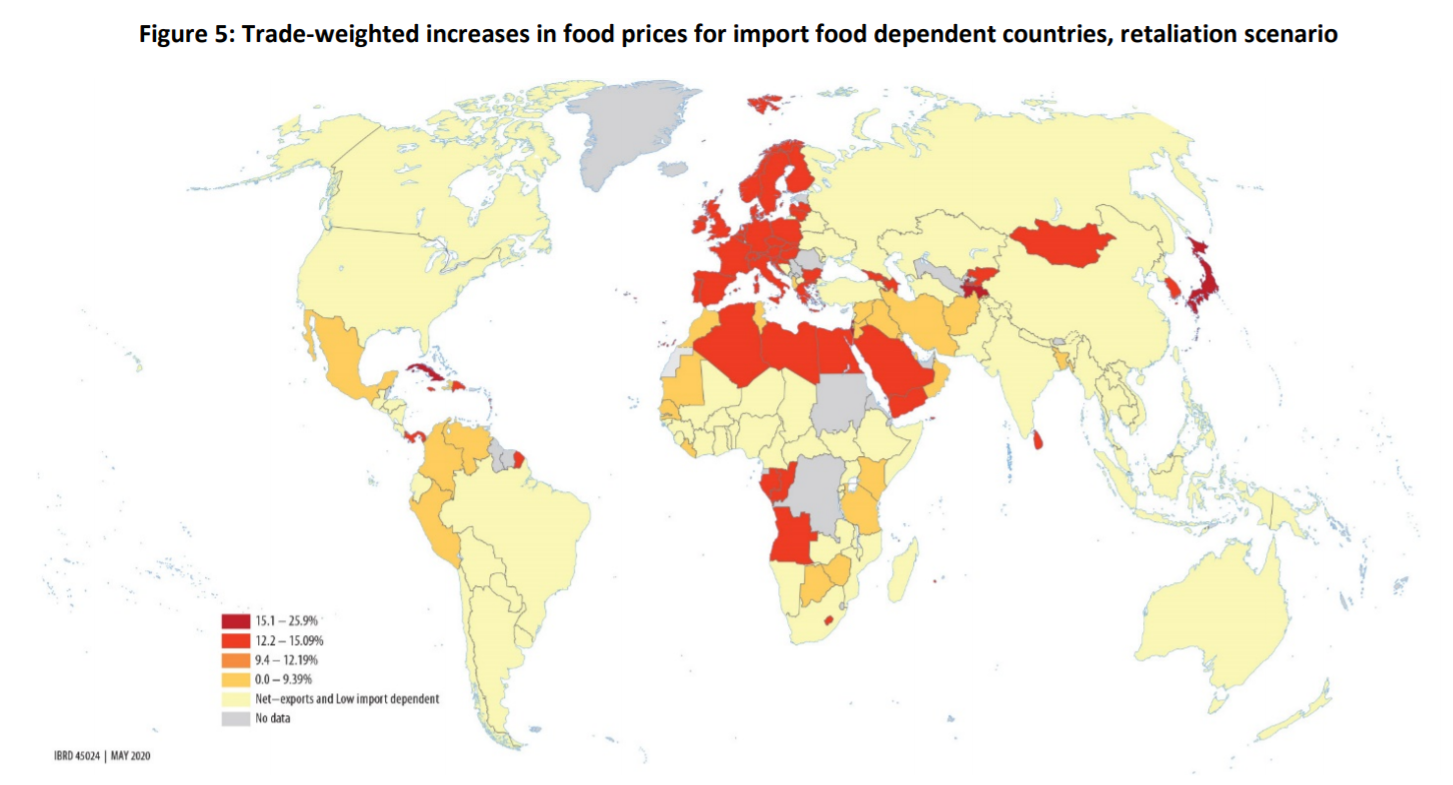
Covid-19 and Food Protectionism The Impact of the Pandemic and Export Restrictions on World Food Markets
Authors: Alvaro Espitia, Nadia Rocha, Michele Ruta
From: World Bank
The way forward for the global food system
The COVID-19 crisis offers a unique opportunity to transform the global food system and make it resilient to future shocks, ensuring environmentally sustainable and healthy nutrition for all. According to the United Nations four broad shifts are necessary in the food system that would:
- Improve resilience by empowering small producers and retailers and mainstreaming them in the food systems;
- Foster regenerative farming by facilitating market access and leveling the financial and regulatory playing field for smaller, sustainable farmers;
- Enhance conservation by breeding fewer animals to accommodate a shift toward more plant-based diets in wealthier countries;
- Promote healthy diets by curbing the over-consumption of animal and highly-processed food in wealthier countries and improving access to good nutrition in poorer ones.
Why Sustainable Food Systems are Needed in a post-COVID World
By: Nicoletta Batini, James Lomax, Divya Mehra – IMF
Digital technologies and agriculture
Digital agriculture – whereby farmers use mobile phones and other digital technologies to access customized, actionable agricultural information in real time – could revolutionize how these communities secure and improve their livelihoods. By making the right investments today, while many agricultural extension officers are restricted from visiting farmers in person, we can kick-start digital adoption and start to close the income gap that has long held rural areas back.
A recent paper co-authored by one of us (Kremer) in Science demonstrates that farmers who received digitally delivered recommendations were 22% more likely to adopt the recommended agrochemical inputs, yielding $10 in benefits for every $1 spent.
Building Forward with Digital Agriculture
By: Michael Kremer, Gilbert F. Houngbo – Harvard University, UN


