Beyond coordination: ideas, independence, and the success of macroeconomic policy
In a speech at the 2025 RBA Annual Conference, Christina D. Romer argued that successful macroeconomic outcomes require not just coordination between monetary and fiscal policy, but coordination in the right direction. Using a series of US historical episodes, Romer shows that “rowing together” can be either a great strength or a serious danger depending on the shared goals and economic ideas guiding policymakers.
Romer organizes the analysis around three types of coordination:
Rowing together (same direction):
- 1933 (Roosevelt) – Coordinated monetary and fiscal expansion ended the Depression; GDP grew 11% in 1933–34.
- 1931 and 1960s–70s (failures) – Coordinated policy in the wrong direction: the 1932 Revenue Act and tight money deepened the Depression; shared overoptimism about the Phillips Curve fueled the Great Inflation.
- Post-pandemic 2020–22 – Overly prolonged coordinated stimulus, driven by a belief that the Phillips Curve was flat, drove core PCE inflation to around 6%.
Rowing apart (uncoordinated):
- Volcker disinflation (1979–83) – Monetary tightening offset Reagan’s tax cuts; inflation fell from 10% to 4%, but only because the Fed resisted political pressure.
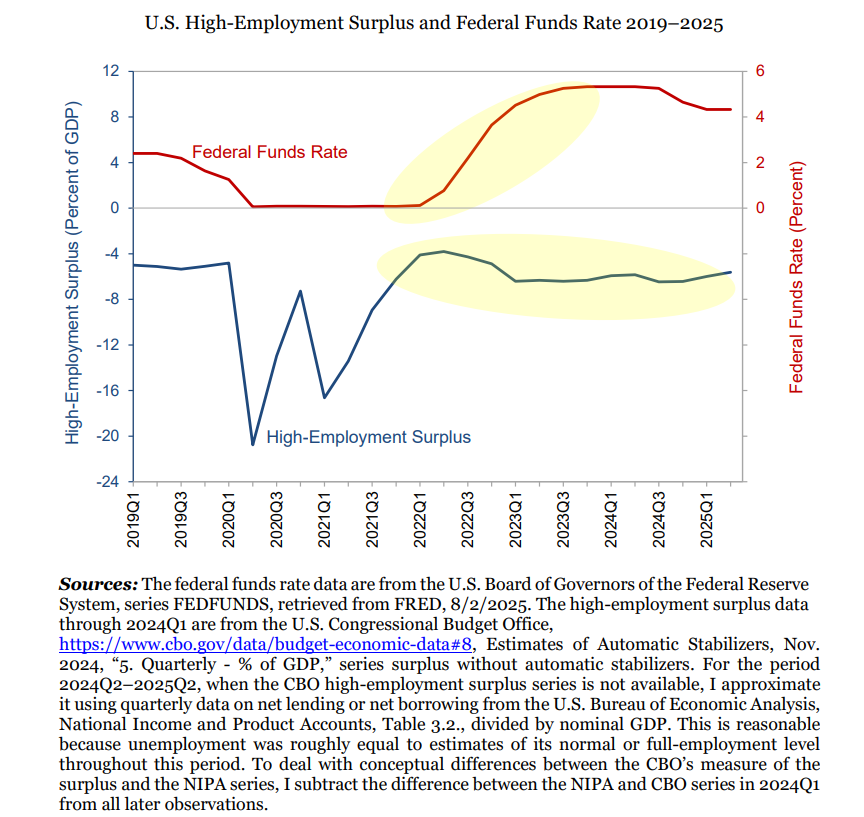
- Post-pandemic disinflation (2022–present) – The Fed’s rate hikes are offsetting expansionary fiscal policy; inflation has fallen substantially but remains sticky above the 2% target.
Rowing apart on purpose (coordinated divergence):
- Bush 1990 and Clinton 1993 fiscal consolidations – Fiscal tightening paired with deliberate monetary easing, aimed at deficit reduction without recession; both episodes were ultimately successful.
Four central lessons:
- Coordination ≠ success. Policy coordination is neither necessary nor sufficient for good outcomes; direction matters more than alignment.
- Economic ideas are decisive. Shared (mis)understandings of the economy, e.g., an unrealistically low natural rate of unemployment or a flat Phillips curve, are the root cause of coordinated policy mistakes.
- Central bank independence is essential. An independent central bank can break a bad coordination equilibrium by refusing to follow misguided fiscal policy; Romer notes this safeguard is “sadly under attack in the United States today.”
- Accurate data and honest fiscal accounts are indispensable. Monetary policy can only play its counteracting role if it has reliable information on the true fiscal stance. Romer warns explicitly against politicizing statistical agencies.
With average OECD debt-to-GDP ratios exceeding 100%, Romer concludes that fiscal consolidation will be a central challenge in coming years.
Rowing Together: Lessons on Policy Coordination from American History
By: Christina D. Romer – University of California, Berkeley
When fiscal and monetary policy collide
Greg Kaplan, in this paper, reviews insights from Heterogeneous-Agent New Keynesian (HANK) models on the interaction between fiscal and monetary policy, with a focus on the Covid-era US macroeconomic experience.
The author uses a calibrated Heterogeneous-Agent New Keynesian (HANK) model in which households face uninsured income risk and borrowing constraints, producing a realistic distribution of marginal propensities to consume. Firms set prices in a state-dependent manner, calibrated to US micro-data on price adjustment. The model is fed two aggregate shocks: a) a demand shock (capturing lockdowns) and b) a supply shock (capturing supply-chain disruptions). Both shocks are estimated to match observed US GDP and inflation from 2020 to 2023. The main empirical exercise runs counterfactual simulations under four scenarios (baseline, no policy, fiscal-only, monetary-only) to isolate the separate contributions of fiscal stimulus and interest rate policy to output, inflation, and the price level during the Covid episode.
On fiscal stimulus and inflation:
- In HANK models (unlike standard representative-agent models), even fully funded fiscal stimulus is inflationary in the short run, because Ricardian equivalence fails and the timing and distribution of transfers matters.
- Unfunded stimulus is more inflationary in HANK than in RANK, because MPC heterogeneity generates real redistribution toward high-MPC households, adding upward pressure on prices.
- The large US fiscal stimulus during Covid was almost entirely responsible for preventing a severe GDP collapse and deflation in 2020–21, but also accounts for the permanent rise in the price level.
On interest rate policy:
- A key and counterintuitive result: raising nominal interest rates without a corresponding fiscal contraction cannot persistently lower inflation and with short-term government debt, it cannot even temporarily lower inflation.
- What actually lowers inflation in standard New Keynesian models is not the rate hike itself, but the accompanying fiscal contraction triggered by passive fiscal rules.
- With long-term debt, rate hikes can temporarily reduce inflation via a “stepping on a rake” effect, but at the cost of permanently higher prices later.
On the Covid episode specifically:
- Without any policy response, US GDP would have fallen twice as much in 2020 and inflation would have peaked at around 15% rather than around 10%.
- Monetary tightening from 2022 smoothed the inflation surge but at the cost of persistently above-trend inflation and lower output in 2022–23, which is consistent with a “soft landing” achieved at a price.
- A funded fiscal stimulus (with future tax repayment starting in 2030) could have achieved the same GDP and price support in 2020–21 without the permanent rise in the price level.
Overall conclusion: monetary and fiscal policy are “inescapably intertwined,” and HANK models, by capturing MPC heterogeneity and the failure of Ricardian equivalence, provide a richer and more realistic framework for quantifying these interactions than standard representative-agent models.
Fiscal-Monetary Interactions in the 2020’s: Some Insights from HANK Models
Authors: Greg Kaplan
From: University of Chicago