


Which features of stablecoins could lead to financial fragility
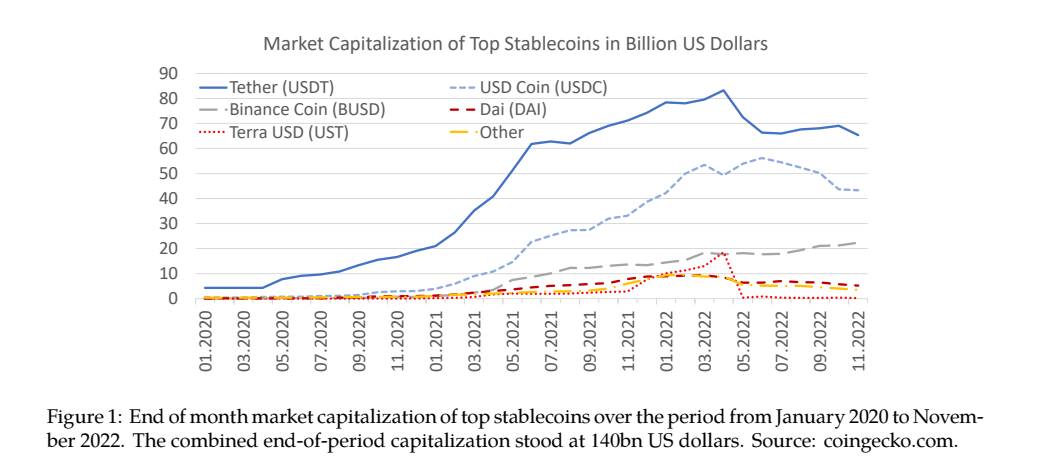
In 2021 the stablecoins market grew almost five-fold until May/June 2022, when the total market capitalization dropped from close to 190bn to around 150bn US dollars after a wave of redemptions. After a short-lived stabilization, the renewed crypto market turmoil in November 2022 caused another correction. In this paper, Christoph Bertsch develops a theoretic framework to study the channels through which crypto assets can lead to financial fragility. He develops a theoretical framework that borrows from existing global games bank run models and incorporates important features of the stablecoins market: the author introduces payment preferences combined with a stablecoins adoption game and studies how they interact with the fragility of the stablecoin issuer. He concludes:
Key determinants of stablecoin fragility are their level of adoption, transaction costs, and network effects, as well as the issuer’s ability to earn revenue from fees and seigniorage. A higher adoption may be destabilizing in case the marginal coin holder becomes flightier or stabilizing due to positive network effects and cost advantages, while congestion effects that cause higher transaction costs in crypto markets during times of distress are stabilizing. The existence of a stablecoin lending market promotes both stability and adoption if the benefits are not undermined by speculation.
Stablecoins: Adoption and Fragility
Author: Christoph Bertsch
From: Sveriges Riksbank
Stablecoins and their impact on the securities that back them
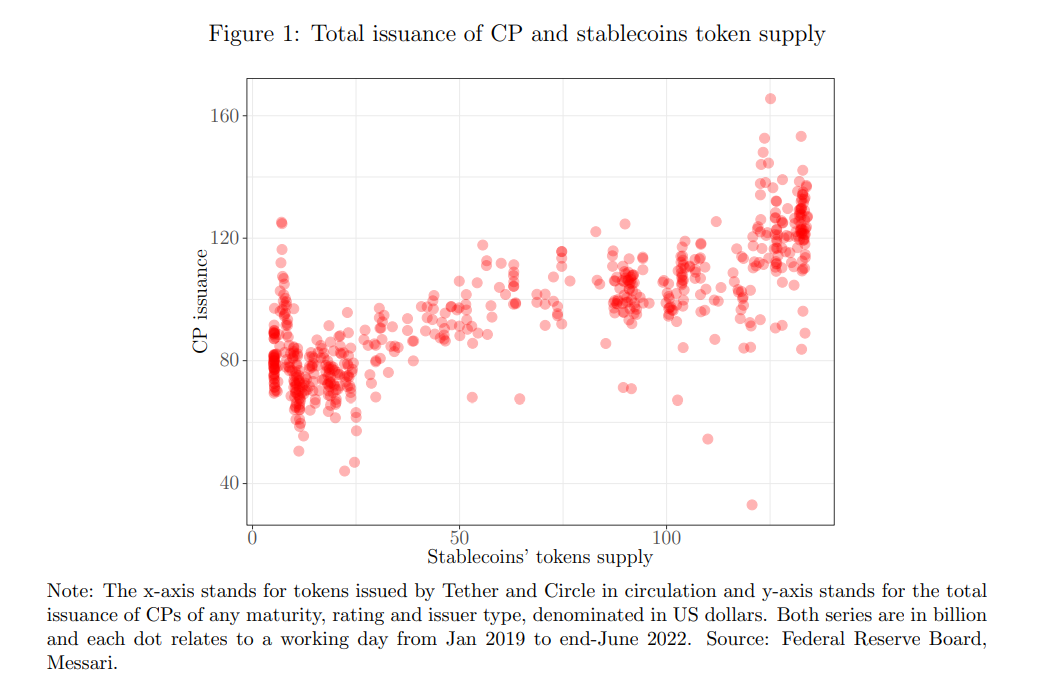
Stablecoins are assumed to be redeemable one-for-one for U.S. dollars by their issuers. To maintain their peg, stablecoins are primarily backed by traditional short-term safe assets held in reserves, such as U.S. Treasuries, bank deposits, or commercial papers. Such a pegging mechanism has created a new demand for US dollar-denominated short-term safe assets. In this paper, Jean et al. investigate how this pegging mechanism creates interconnections between the crypto-asset sphere and conventional financial markets and how they eventually modify the funding structure of the economy. The authors track the issuance of stablecoins on publicly available blockchain data and construct a dataset of daily changes in the amount of stablecoins in circulation. By studying the empirical link between the amount of stablecoins in circulation and the issuance of USD-denominated commercial paper (CP) by nonfinancial or financial corporates, they find:
Through several empirical strategies, we show that stablecoins have caused more issuance of CP while there were used as reserve assets for stablecoins, both statistically and economically significant, confirming the correlation in the figure below. These results suggest that the issuers of CP, notably US companies and US financial institutions, react to the increasing demand for stablecoins by issuing more CP, with no impact on CP rates. Thus, the development of crypto-assets indirectly affects the financing of the real economy.
Stablecoins and the Financing of the Real Economy
Authors: Barthélemy Jean, Gardin Paul, Nguyen Benoît
From: Banque de France
