OECD economies enter the coronavirus crisis with a large share of their labor force in solo self-employment
Boeri and al. find that in the last 20 years, most OECD countries experienced a major change in the composition of self-employment: the share of self-employed persons who operate on their own without having dependent workers on their payroll—or solo self-employment—increased almost everywhere relative to the other self-employment. What does this change in employment structure mean for the well-being of workers?
- Solo self-employment appears to be an intermediate category between employment and unemployment. It shares important characteristics with underemployment;
- Many workers are hourly and liquidity constrained and earn less than workers in traditional jobs and in self-employment with employees, even on an hourly basis;
- A substantial share of solo self-employed workers are vulnerable to idiosyncratic shocks because a single client provides more than 50 percent of their earnings;
- Most solo self-employed workers don’t have any social protection.
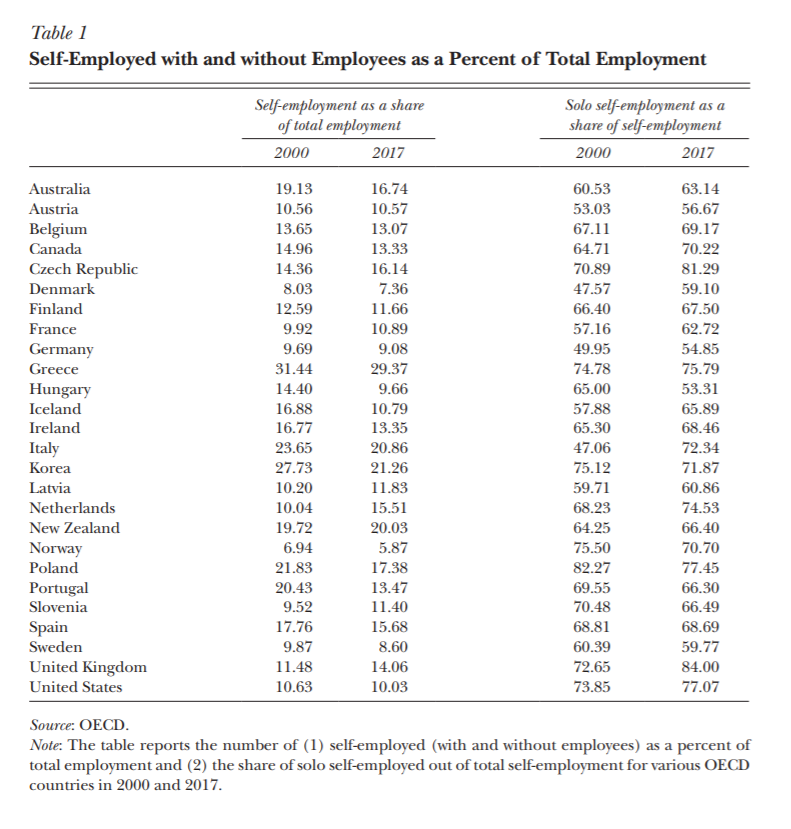
Solo Self-Employment and Alternative Work Arrangements: A Cross-Country Perspective on the Changing Composition of Jobs
Authors: Tito Boeri, Giulia Giupponi, Alan B. Krueger, Stephen Machin
From: Bocconi University, Princeton University, London School of Economics
Learning and work prospects for young people
Peter Temin, Professor Emeritus of Economics at MIT, explains how the coronavirus epidemic will affect today’s young people:
- The ones working in the gig economy are going to get “squashed down” with fewer and fewer opportunities and completely uninsured income;
- Online learning, if it becomes normalized, is a very bad idea: it will condemn poor young people to remain poor as they won’t be in a place where somebody can recognize their talent and can take them on.
MIT Economist on Coronavirus: Young People “Going to Get Squashed”
By: Lynn Parramore – INET
For the full-time employed workers: who is in danger?
Branko Milanovic differentiates between four types of laborers: a) doctors and medical personnel, b) online retail workers, c) people producing physical goods (factory workers), and d) professionals (teachers, engineers, designers etc.). The pandemic shock increases exponentially the demand for doctors and online retail workers, but it decreases the demand for factory workers, and more or less leaves the demand for professionals unchanged.
It is therefore the factory workers who should be the main focus of policy-making: they should not be allowed to fall below some income threshold (for the reasons of both humanity and broader social interest), while at the same time they should not go to work in order to slow the rate of new infections. This implies that entire focus of policy needs to change from financial indicators to household incomes.
Four types of labor and the epidemic
By: Branko Milanovic – City University of New York


