


Who is investing in crypto and why
Weber et al. use a series of large quantitative surveys of U.S. households, to study the prevalence of crypto-ownership among U.S. households, the reasons some households choose to hold Bitcoin and others don’t, the perceived risks and benefits of cryptocurrency as an investment, and the effects of crypto price volatility on the spending decisions of its investors. They find:
- The share of people owning any cryptocurrency rose sharply between 2021 and 2022 when Bitcoin prices were rising, from around 3% to 11%. As Bitcoin prices fell precipitously thereafter, the share of people holding any crypto rose further to 12%.
- Cryptocurrency investors are disproportionately white, young, male with higher incomes, Libertarian, or otherwise politically independent.
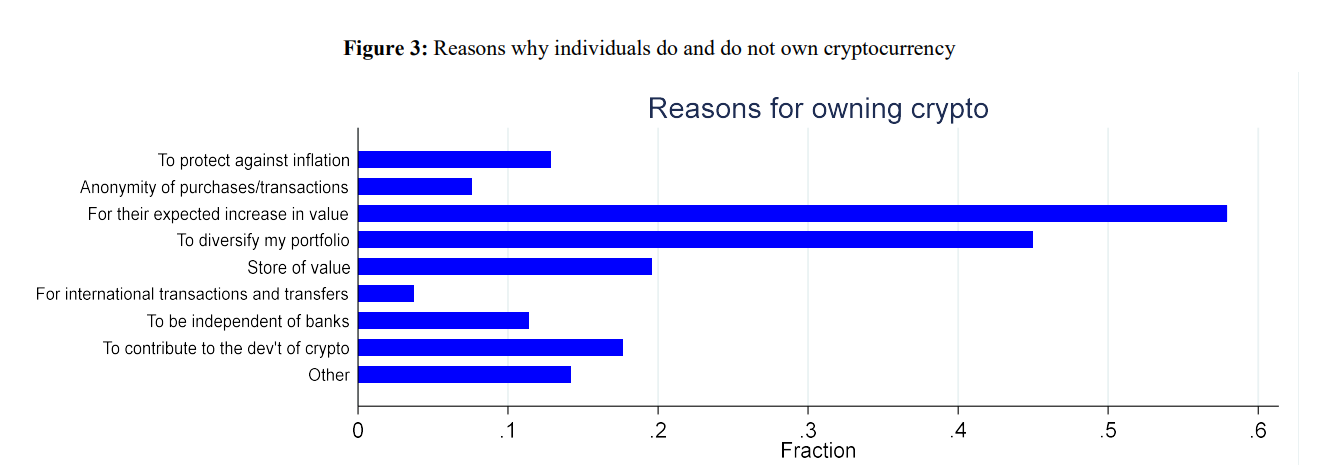
- Crypto-holders most commonly justify their decision through the high expected returns of cryptocurrency, followed by a desire for a diversified portfolio. Other commonly cited reasons include a store of value and hedge against inflation as well as a desire to support the development of cryptocurrencies.
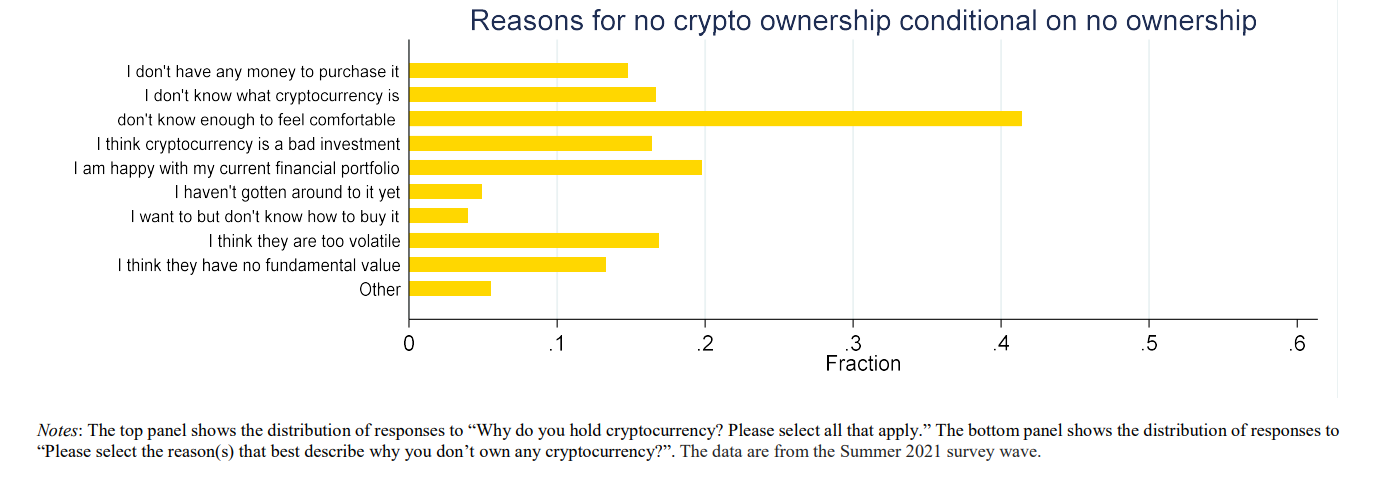
In many respects, we find that cryptocurrency is in fact quite different. First, it is unique in the extent to which most individuals are uninformed about it: the share of people who are unwilling to even hazard a guess for the expected return is higher for crypto than for any other type of asset. Second, those who make predictions about future returns do so in ways that are strikingly different from what we observe for other assets.
Do You Even Crypto, Bro? Cryptocurrencies in Household Finance
Authors: Michael Weber, Bernardo Candia, Olivier Coibion, Yuriy Gorodnichenko
From: University of Chicago, UC Berkeley, UT Austin
Crypto, Libertarianism, and Twitter
Are crypto investors motivated by distrust in fiat currencies? No, argue Auer and Tercero-Lucas.
They use data from the U.S. Survey of Consumer Payment Choice to disprove the common narrative that the creation of cryptocurrencies is driven by a desire to “design an alternative to fiat money and commercial banking, with the goal of creating a new form of exchange that is resistant to debasement and censorship by governments and financial institutions.”
Auer and Tercero-Lucas also find that Twitter is an important source of information for crypto-investors. In particular, they find that the number of tweets concerning Bitcoin can predict the next day’s trading volume and volatility.

Merkley et al. further confirm the importance of “Crypto-Influencers,” or social media analysts covering crypto asset securities on Twitter.
Using a sample of over 35,000 tweets issued by 180 prominent cryptocurrency-related Twitter accounts, we find that tweets mentioning specific crypto assets are associated with significantly positive short-run returns but are also associated with significantly negative long-horizon returns. This evidence is consistent with influencer’s having pump-and-dump incentives or at the very least it suggests that influencers provide poor investment advice, on average.
Distrust or speculation? The socioeconomic drivers of US cryptocurrency investments
Authors: Raphael Auer, David Tercero-Lucas
From: Bank for International Settlements (BIS), Universitat Autònoma de Barcelona
Crypto-Influencers
Authors: Kenneth J. Merkley, Joseph Pacelli, Mark Piorkowski, Brian Williams
From: Indiana University, Harvard Business School
