• Twitter
  • Search
e-axes

360° Econ View

The issues, the debates, and the research

  • Home
  • Useful Data
  • About
  • Contact
  • Home
  • Useful Data
  • About
  • Contact

Climate

Climate change and r*

Posted by e-axes on November 1, 2022

Read Next →

Climate

Is Economic Growth Compatible With Credible Climate Constraints?

Climate

Can Financial Markets and Economic Literacy Reshape the Politics of Climate? Action

Climate

The Cost of Inconsistent and Incredible Climate Policy

Effect of climate change on r*

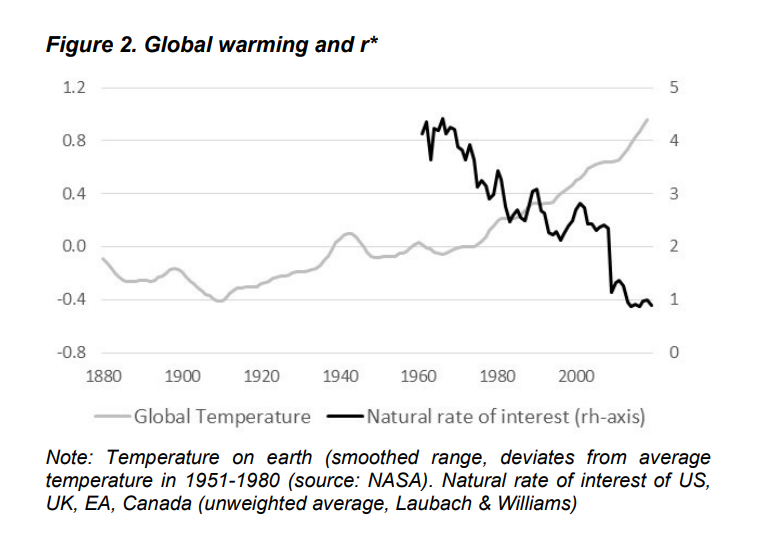
In this paper Mongelli et al. review the channels through which climate change can affect r*, namely demography, productivity and risk aversion (in the form of higher precautionary savings). They find that climate change mostly has a dampening effect on r*. They then discuss the main models used to simulate the effects of climate change on r* and conclude that the downward effects of climate change on r* can be substantial, even taking into account the high degree of uncertainty.

Lower levels of the natural rate of interest reduce a central bank’s policy space since it increases the likelihood that the ELB becomes binding. This adds to the uncertain impact of climate change on the output gap, which would also imply that guidance from Taylor rules weakens. The reduced policy space for conventional monetary policy might only partly be compensated for by unconventional policy tools like QE. Therefore, it will be important to conduct policies that can help to avoid hitting the ELB, including fiscal policy. Government measures are the most obvious and effective way to foster to transition to a climate-neutral economy. An orderly transition will mitigate the economic and financial risks of climate change and thereby also prevent potential downward effects on r*.

The effects of climate change on the natural rate of interest: a critical survey
Authors: Francesco Paolo Mongelli, Wolfgang Pointner, Jan Willem van den End
From: ECB

Conceptualizing the relation between r* and climate change

In this paper Nicholas Muller takes a different approach by answering the question of whether a central bank can operationalize management of environmental pollution and climate risk through monetary policy. He proposes a green interest rate, r(g), that transmits information on pollution damages to borrowers and lenders. It is actually a reconceptualization of the natural interest rate, r*, that recognizes an expanded role for central banks inclusive of managing environmental risks. Muller develops a New Keynesian model where output is produced with polluting technologies and consumers face the neoclassical consumption-savings problems. The solution that accounts for pollution damage yields r(g), while the solution without the pollution damage yields r*. He argues that in economies on a cleaning-up path, r(g) exceeds r* but for those growing more polluted, r(g) is less than r*.

[T]he goal of this paper is to demonstrate how a central bank could apply r(g) autonomously; that is, without coordinating with an environmental regulator charged with enactment of traditional environmental policy (such as a Pigouvian tax). Political and social obstacles to meaningful climate policy in the near term render this context most broadly relevant.


On the Green Interest Rate
Authors: Nicholas Z. Muller
From: Carnegie Mellon University

Print Friendly, PDF & Email

e-axes

Read Next →

Climate

Is Economic Growth Compatible With Credible Climate Constraints?

Climate

Can Financial Markets and Economic Literacy Reshape the Politics of Climate? Action

Climate

The Cost of Inconsistent and Incredible Climate Policy

Comments are Closed

Account

  • Login

Subscriptions

You are not logged in.
Login
Subscribe

Subscriptions

Subscribe

Most Read

  • Gold, the Dollar, and the Geopolitics of Global Reserves
  • China and the Political Economy of Critical Minerals
  • Public Debt Maturity and Macroeconomic Policy Transmission
  • Bank Heterogeneity and the Transmission of Monetary Tightening
  • AI, Knowledge and the Future of Human Expertise
  • AI Valuations, Capital Investment, and Growth
  • New and Noteworthy Books in Economics (September)
  • AI and the Natural Rate: Puzzle or Policy Challenge?
  • Transfers, Taxes, and the Ricardian Equivalence
  • Can Institutions Limit the Economic Damage of Populism?

Sections

  • AI
  • Banking
  • Books
  • Brexit
  • CBDC
  • China
  • Climate
  • COVID-19
  • Crypto
  • Demographics
  • Economic Growth
  • Economic Science
  • Economics of Information
  • Emerging Markets
  • Eurozone
  • Financial Markets
  • Geoeconomics
  • Geopolitics
  • India
  • Inequality
  • Inflation
  • International Economics
  • Macro
  • Markets
  • Monetary Policy
  • Oil
  • Politics & Economics
  • Taxation
  • Tech
  • Trade
  • U.S.
  • Ukraine-Russia War
  • Uncategorized
  • Useful Data

© 2026 e-axes

  • Privacy Policy & Terms of Service

Theme by Anders Norén

This website uses cookies to improve your experience. We'll assume you're ok with this, but you can opt-out if you wish.
Cookie settingsAccept
Privacy & Cookies Policy

Privacy Overview

This website uses cookies to improve your experience while you navigate through the website. Out of these cookies, the cookies that are categorized as necessary are stored on your browser as they are as essential for the working of basic functionalities of the website. We also use third-party cookies that help us analyze and understand how you use this website. These cookies will be stored in your browser only with your consent. You also have the option to opt-out of these cookies. But opting out of some of these cookies may have an effect on your browsing experience.
Necessary
Always Enabled
Necessary cookies are absolutely essential for the website to function properly. This category only includes cookies that ensures basic functionalities and security features of the website. These cookies do not store any personal information.
SAVE & ACCEPT