• Twitter
  • Search
e-axes

360° Econ View

The issues, the debates, and the research

  • Home
  • Useful Data
  • About
  • Contact
  • Home
  • Useful Data
  • About
  • Contact

Politics & Economics

Are we headed toward a polycrisis?

Posted by e-axes on February 9, 2023

Read Next →

Politics & Economics

Can Institutions Limit the Economic Damage of Populism?

Politics & Economics

From Citizens’ Anger to Central Bankers’ Frowns!

Politics & Economics

Political Risk and Sovereign Debt Sustainability

What is a polycrisis?

The World Economic Forum’s 2023 Global Risks Report uses the term, to explain how “present and future risks can also interact with each other to form a ‘polycrisis’ – a cluster of related global risks with compounding effects, such that the overall impact exceeds the sum of each part”. The report cites the below short-term and long-term risks for which there is no quick solution:
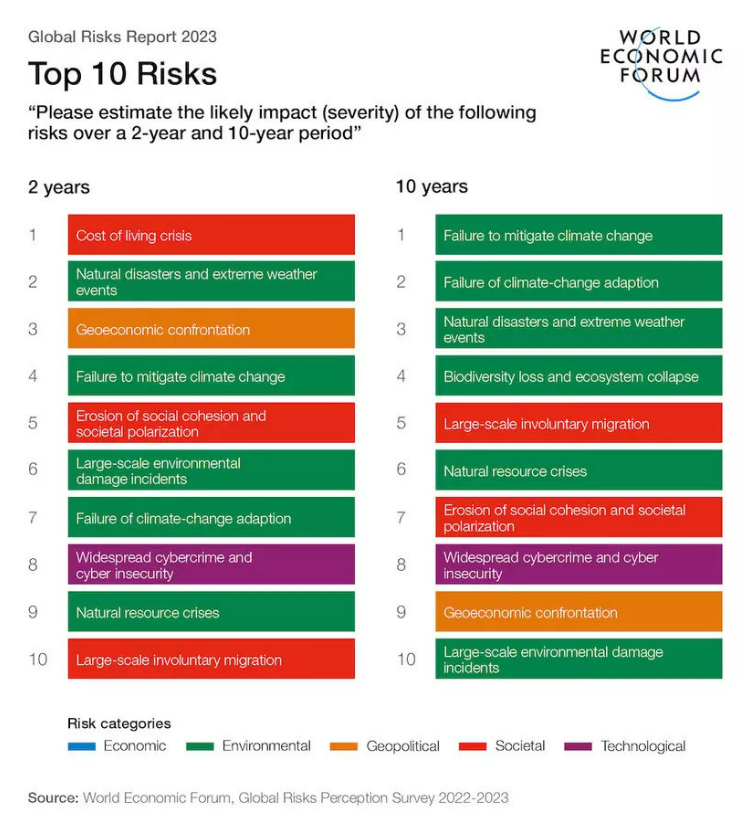
We’re on the brink of a ‘polycrisis’ – how worried should we be?
From: World Economic Forum

Polycrisis: a too pessimistic scenario

Not true, argues Noah Smith, there are solutions to the above crises because there are buffer mechanisms i.e. the global economy and political system are full of mechanisms that push back against shocks.

I look out in the world and I don’t see a polycrisis; I see an emerging polysolution. The looming threats of climate change and authoritarian revanchism, combined with the shocks of Covid and inflation, have stirred both policymakers and businesses to action. And many of those actions will end up addressing multiple crises rather than just one.
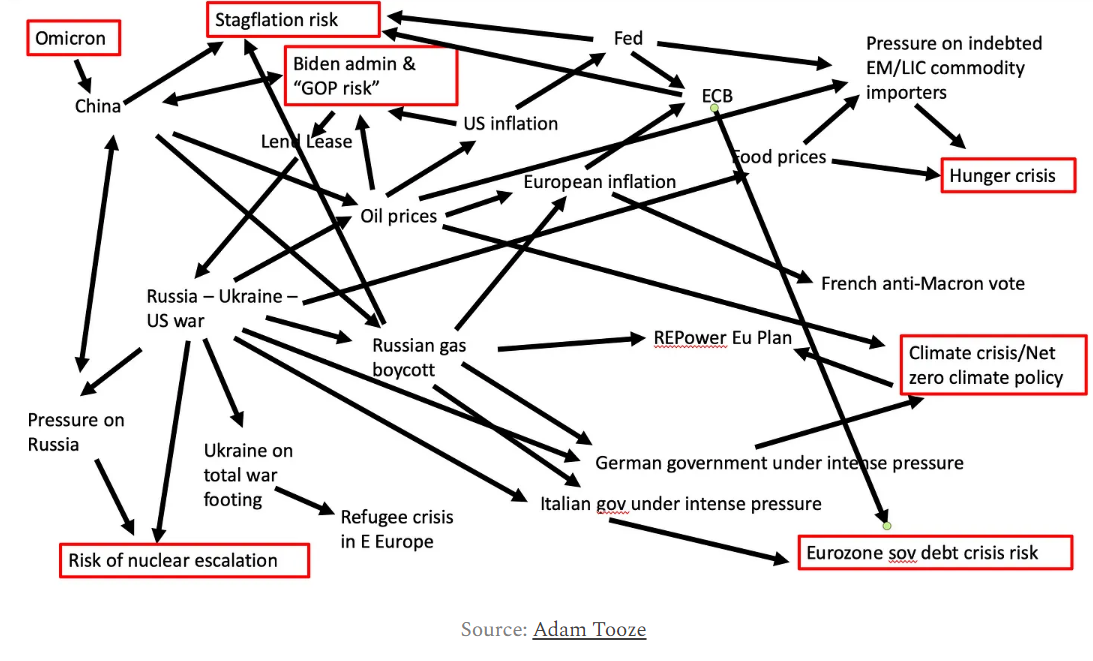

Against “polycrisis”
By: Noah Smith

Polycrisis: the wrong way to look at the current situation

Farwa Sial argues that a better way to understand the current state of the world is by looking at the structural weaknesses of key developed economies in the West:

Not a polycrisis, instead recent events including the Covid-19 pandemic, climate change catastrophes, the Russian invasion of Ukraine, and the rise in energy and food prices are generally postulated as separate crises, which can have an effect on each other but nevertheless have separate origins. This centrifugal analysis of events predicates on the decline of the uni-polar world order, as well as acknowledging the emergent structural weaknesses in the traditional western powers; all of which can be loosely interpreted as occurring in a period during which power is dispersing and perhaps as a consequence of this dispersion, the current drivers of crisis have multiplied, leading to a multitude of crises, in contrast to preceding historical instances.

Whose Polycrisis?
By: Farwa Sial – University of Manchester

Print Friendly, PDF & Email

e-axes

Read Next →

Politics & Economics

Can Institutions Limit the Economic Damage of Populism?

Politics & Economics

From Citizens’ Anger to Central Bankers’ Frowns!

Politics & Economics

Political Risk and Sovereign Debt Sustainability

Comments are Closed

Account

  • Login

Subscriptions

You are not logged in.
Login
Subscribe

Subscriptions

Subscribe

Most Read

  • Bank Heterogeneity and the Transmission of Monetary Tightening
  • AI Valuations, Capital Investment, and Growth
  • New and Noteworthy Books in Economics (September)
  • AI and the Natural Rate: Puzzle or Policy Challenge?
  • Communicating Uncertainty: Fan Charts, Confidence, and Credibility
  • Macroeconomic Risk: From Scenario Synthesis to Distributional Transmission
  • How Firms’ Cost Expectations Shape Prices
  • Transfers, Taxes, and the Ricardian Equivalence
  • Can Institutions Limit the Economic Damage of Populism?
  • Asia’s Expanding Non-Dollar Payment Networks

Sections

  • AI
  • Banking
  • Books
  • Brexit
  • CBDC
  • China
  • Climate
  • COVID-19
  • Crypto
  • Demographics
  • Economic Growth
  • Economic Science
  • Economics of Information
  • Emerging Markets
  • Eurozone
  • Financial Markets
  • Geoeconomics
  • Geopolitics
  • India
  • Inequality
  • Inflation
  • International Economics
  • Macro
  • Markets
  • Monetary Policy
  • Oil
  • Politics & Economics
  • Taxation
  • Tech
  • Trade
  • U.S.
  • Ukraine-Russia War
  • Uncategorized
  • Useful Data

© 2026 e-axes

  • Privacy Policy & Terms of Service

Theme by Anders Norén

This website uses cookies to improve your experience. We'll assume you're ok with this, but you can opt-out if you wish.
Cookie settingsAccept
Privacy & Cookies Policy

Privacy Overview

This website uses cookies to improve your experience while you navigate through the website. Out of these cookies, the cookies that are categorized as necessary are stored on your browser as they are as essential for the working of basic functionalities of the website. We also use third-party cookies that help us analyze and understand how you use this website. These cookies will be stored in your browser only with your consent. You also have the option to opt-out of these cookies. But opting out of some of these cookies may have an effect on your browsing experience.
Necessary
Always Enabled
Necessary cookies are absolutely essential for the website to function properly. This category only includes cookies that ensures basic functionalities and security features of the website. These cookies do not store any personal information.
SAVE & ACCEPT