


Green transition policies and price stability
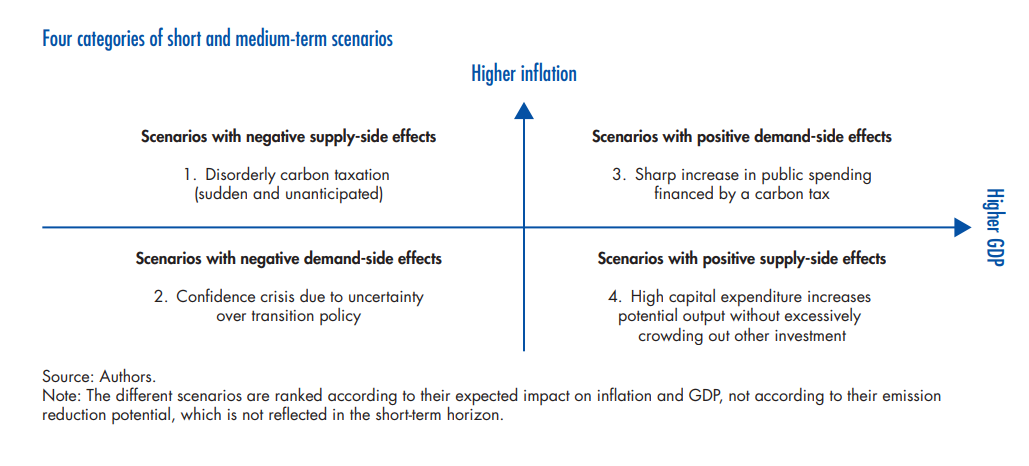
Green transition policies could affect inflation through delays in the relative price adjustment of energy-intensive goods, or economic disruptions linked to the restructuring and adaptation of the productive system. In this paper, Dees et al. analyze the impact of green transition policies on inflation in France by looking at four standard scenarios corresponding to representative cases of transition-related shocks:
- Scenario 1: Abrupt and unanticipated increase in the price of carbon. This scenario assumes an increase of USD 400 per ton in the carbon tax over the first three years which is revenue-neutral. Such a steep increase, the authors estimate, will lead to a rapid rise in inflation in France of up to 1.75 percentage points in the annual rate in the first year, and 0.6 percentage points after five years.
- Scenario 2: Temporary increase in uncertainty regarding transition policies. This scenario assumes an increase of 100 basis points in firms’ cost of financing in the financial markets and a decrease in household consumption. Although the initial impact is deflationary, after five years, this scenario shows a moderate increase in inflation.
- Scenario 3: Strong increase in public investment financed by a carbon tax. This scenario assumes a public expenditure of around EUR 27 billion per year for France, which is assumed to be paid through revenues generated by carbon taxes. In this case, inflation gradually increases up to 1.75 percentage points but declines in the second year.
- Scenario 4: Sharp rise in private investment at the expense of consumption. The considerable increase in private investment is in the form of tax credits to companies, financed by an increase in household income tax. This scenario will be deflationary with a 0.8 percentage decrease year-on-year.
The transition to carbon neutrality: effects on price stability
Authors: Stéphane Dees and Oriane Wegner, Annabelle de Gaye, Camille Thubin
From: Banque de France
